





What's Happening?
A recent study published in January 2026 has provided new insights into the geological history of Jezero Crater on Mars. The study, led by researchers from Imperial College London, analyzed the 'Margin unit' along the crater's western rim, which has been
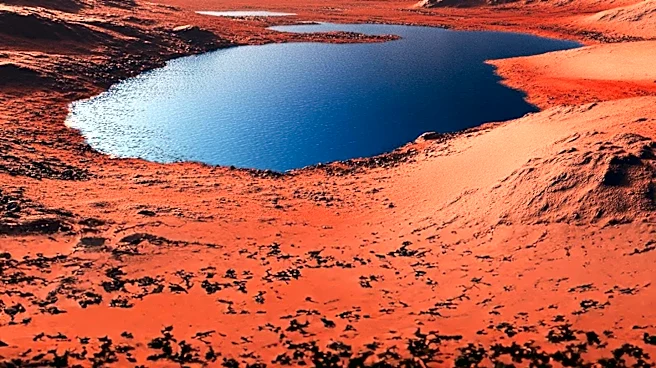
a subject of debate regarding its origin. The research suggests that the Margin unit consists of both sedimentary deposits and altered igneous rock, indicating a complex history of water interaction. The eastern part of the unit shows evidence of a former lakeshore, with sandstone layers reworked by ancient waves, suggesting the presence of a beach. This finding extends the understanding of potentially habitable conditions on Mars, as it implies a prolonged period of surface water presence.
Why It's Important?
The study's findings are significant for understanding Mars' geological and climatic history, particularly the role of water in shaping its surface. The presence of a former lakeshore suggests that Jezero Crater had conditions that could have supported life, making it a key area for astrobiological research. The research also highlights the complexity of Mars' water history, which is crucial for future exploration missions aiming to uncover signs of past life. By providing evidence of both sedimentary and igneous processes, the study enhances the scientific community's ability to reconstruct Mars' environmental history and assess its habitability potential.