



What's Happening?
Texas Governor Greg Abbott has threatened to revoke state grant funds for Dallas-Fort Worth International Airport (DFW) and George Bush Intercontinental Airport (IAH) in Houston over the presence or plans for Islamic pre-prayer ablution (wudu) stations.
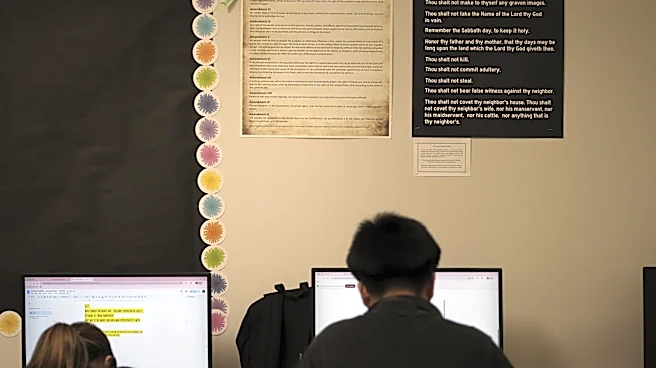
Abbott accused the airports of 'religious discrimination,' stating that these facilities 'appear designed to single out one subset of the population for special treatment based on religion,' which he claims is illegal for government-owned facilities. Following Abbott's threat, DFW Airport scrapped its plans for wudu stations, citing that the project would not deliver the 'originally anticipated operational benefits.' The Council on American–Islamic Relations (CAIR) has condemned Governor Abbott's actions, calling them an 'anti-Muslim political stunt' and arguing that wudu stations are similar to interfaith prayer rooms or bidets and are open for anyone to use, not just Muslims. CAIR also highlighted Abbott's previous actions, such as signing a law requiring the display of the Ten Commandments in schools.
Why It's Important?
This controversy underscores a significant debate regarding religious freedom, government neutrality, and the accommodation of diverse religious practices in public spaces within the U.S. Governor Abbott's stance raises questions about the interpretation of the First Amendment's Establishment Clause, which prohibits the government from establishing or favoring any religion. While Abbott argues that providing wudu stations constitutes favoritism, civil rights advocates contend that offering religious accommodations in public facilities is a legitimate exercise of religious freedom and does not violate the law, especially when such facilities are accessible to all. The incident also highlights growing concerns about Islamophobia in U.S. politics, as CAIR suggests Abbott's actions are part of a pattern of anti-Muslim rhetoric. The decision by DFW Airport to cancel its plans under political pressure could set a precedent for other public institutions to reconsider similar accommodations, potentially limiting religious expression in public spaces.
What's Next?
CAIR is likely to continue its advocacy against what it perceives as anti-Muslim political stunts by Governor Abbott, potentially through public statements, legal challenges, or community organizing. The issue may also prompt further debate and scrutiny from civil liberties organizations and interfaith groups regarding the appropriate balance between religious accommodation and government neutrality. Airports and other public facilities in Texas and potentially across the U.S. might re-evaluate their policies on religious accommodations to avoid similar political controversies. The broader political climate, particularly concerning religious freedom and the separation of church and state, will continue to be influenced by such incidents, potentially leading to increased polarization or, conversely, renewed efforts to foster inclusive public spaces.
Beyond the Headlines
This event delves into the deeper societal implications of religious pluralism and the challenges of integrating diverse cultural and religious practices into a secular public sphere. The argument that wudu stations are 'no different than the interfaith prayer rooms or toilet bidets' points to a fundamental question of what constitutes a reasonable accommodation versus special treatment. The controversy also reflects a broader cultural struggle over identity and belonging, particularly for minority religious groups in the U.S. The political pressure exerted by Governor Abbott, leading to the cancellation of the DFW project, illustrates how political rhetoric can directly impact the daily lives and religious practices of citizens. This incident could further fuel discussions about the role of government in regulating religious expression and the potential for political figures to weaponize religious issues for political gain, contributing to a climate of intolerance or misunderstanding.