



What's Happening?
An international team of researchers, led by the University of Bristol, has identified a new species of prehistoric animal, Dinodontosaurus isiyavamanda, from 240-million-year-old fossils found in Tanzania. This discovery, published in the Journal of Vertebrate
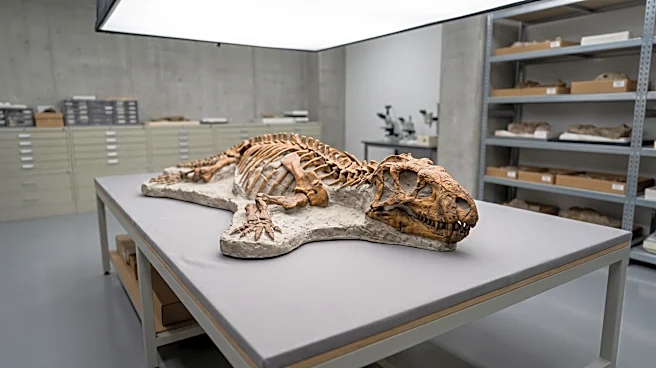
Palaeontology, challenges previous assumptions about the age of one of the world's most significant fossil sites and could revise the timeline of early dinosaur evolution. The fossils, part of an extensive collection of synapsids (mammal-lineage vertebrates) discovered in 1963 and housed at the Natural History Museum, London, were previously only partially studied. The research team examined an undescribed associated skeleton and a more recently found fragmentary skull, confirming its classification within the Dinodontosaurus genus, which was previously known only from South America. The name 'isiyavamanda' references the Wamanda people of the region where the fossils were found. This finding establishes a new link between Tanzanian and South American rock sequences, indicating they are of equivalent age.
Why It's Important?
The discovery of Dinodontosaurus isiyavamanda in Tanzania is significant because it provides crucial evidence that the geological deposits in Tanzania, previously thought to contain the oldest potential dinosaur fossils, may be younger than initially believed. New radiometric dating from South America suggests that early dinosaur-bearing rock sequences there are up to 10 million years younger than those in South Africa. By linking the Tanzanian and South American fossil records through this new species, researchers can now infer that the Triassic rocks in Tanzania are also younger, thereby prompting a reassessment of when and where dinosaurs first evolved. This re-evaluation has profound implications for understanding the global distribution and evolutionary history of early life forms, particularly the origins of dinosaurs. It highlights the ongoing importance of re-examining existing museum collections, as these can yield new insights that fundamentally alter scientific understanding of Earth's ancient past.
What's Next?
Future research will involve further examination of the remaining Tanzanian Dinodontosaurus material, particularly the postcranial skeleton. Researchers plan to investigate the anatomy of these remains and compare them with South American specimens to gain a more comprehensive understanding of the species. Additionally, the team intends to study the biomechanics of Dinodontosaurus and related dicynodonts. This will help to elucidate how multiple large herbivorous species managed to coexist in Triassic ecosystems. The ongoing analysis of these fossils and their geological context is expected to continue refining the timeline of dinosaur origins and provide deeper insights into the paleoecology of the Triassic period. The discovery also underscores the value of international collaboration and the application of modern techniques, such as Micro CT scanning, in paleontological research.
Beyond the Headlines
This discovery extends beyond merely identifying a new species; it fundamentally shifts our understanding of ancient continental connections and the dispersal of prehistoric life. The presence of Dinodontosaurus in both South America and East Africa provides compelling evidence for the interconnectedness of these landmasses during the Triassic period, supporting the theory of Pangaea. This biogeographical link offers a 'snapshot' of the planet 240 million years ago, illustrating how species could migrate across what are now vastly separated continents. The re-dating of the Tanzanian fossil sites also highlights the dynamic nature of scientific knowledge, where established timelines can be revised with new evidence and advanced analytical techniques. It emphasizes the critical role of museum collections as invaluable archives of Earth's history, demonstrating that even long-held specimens can yield groundbreaking discoveries when revisited with fresh perspectives and modern tools.