










What's Happening?
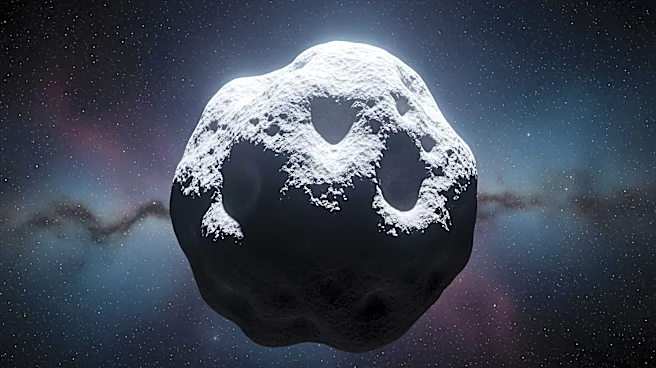
NASA's Lucy spacecraft has provided new insights into the asteroid Donaldjohanson, revealing it as a wobbly, peanut-shaped body with a complex rotation. The asteroid, formed from fragments after a collision 155 million years ago, was observed to have
a two-axis rotation. The spacecraft's flyby in April 2025 captured detailed images and data, showing the asteroid's unique shape and surface features. The mission serves as a precursor to Lucy's primary encounters with Jupiter's Trojan asteroids, offering a rare opportunity to study an unexplored asteroid up close.
Why It's Important?
The findings from Lucy's encounter with Donaldjohanson enhance our understanding of asteroid dynamics and formation. The asteroid's unique rotation and shape provide valuable data for comparing with other asteroids like Bennu and Ryugu, which have been studied in previous missions. This knowledge contributes to the broader understanding of solar system formation and the processes that shape celestial bodies. The mission underscores the importance of studying diverse asteroid populations to gain insights into the history and evolution of the solar system.
What's Next?
Lucy is set to continue its journey towards the Trojan asteroids, with its next major encounter scheduled for August 2027. The mission will provide further opportunities to study these ancient space rocks, which hold clues to the early solar system. The data collected from Donaldjohanson will be analyzed alongside future findings, helping scientists refine models of asteroid behavior and evolution. As Lucy progresses, it will contribute to a deeper understanding of the solar system's history and the forces that have shaped it.