



What's Happening?
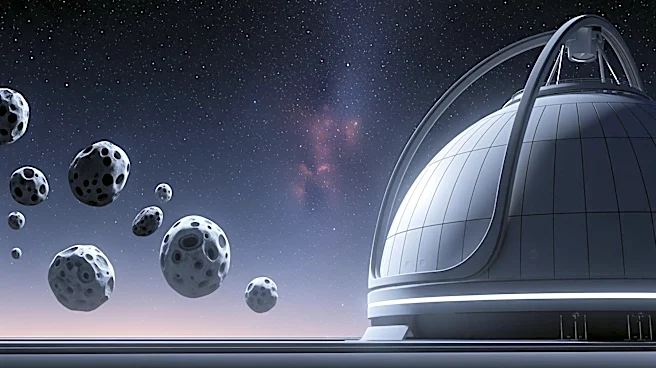
Astronomers at the Vera C. Rubin Observatory, part of the United States National Science Foundation (NSF) and Department of Energy, have made a significant discovery by detecting over 11,000 new asteroids. This includes 33 previously unknown Near-Earth
Objects (NEOs). The findings were submitted to the International Astronomical Union’s Minor Planet Center, marking the largest single batch of asteroid discoveries in the past year. The observations were made over a month-and-a-half period, involving around a million observations. Among these, some asteroids had been previously observed but were lost due to uncertain orbits. The largest of the newly discovered NEOs is approximately 1,640 feet wide, but none pose a threat to Earth.
Why It's Important?
The discovery of these asteroids is crucial for planetary defense and scientific research. The Rubin Observatory's ability to detect such a large number of asteroids in a short time frame demonstrates its potential to significantly enhance our understanding of the solar system. By identifying and monitoring NEOs, the observatory plays a vital role in assessing potential threats to Earth. The NSF notes that only about 40% of mid-sized NEOs have been identified, highlighting the importance of continued monitoring. This discovery could lead to advancements in predicting and mitigating potential asteroid impacts, thereby safeguarding the planet.
What's Next?
The Rubin Observatory is expected to continue its work, potentially uncovering around 90,000 new NEOs, some of which may be hazardous. The observatory aims to nearly double the number of known NEOs larger than 460 feet. This ongoing research will provide valuable data for planetary defense strategies and contribute to the broader scientific understanding of the solar system. The observatory's future findings could lead to new discoveries and insights into the formation and evolution of celestial bodies.