



What's Happening?
China's Tianwen-2 spacecraft has successfully arrived at the near-Earth asteroid Kamo'oalewa, marking a significant milestone in its mission. Launched in May 2025, the spacecraft traveled approximately 1 billion kilometers over 400 days to reach the asteroid.
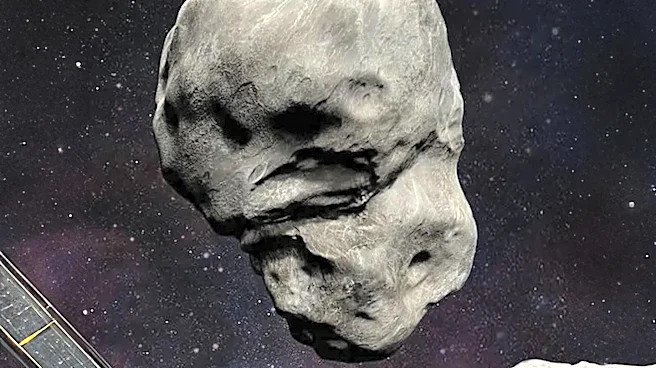
The China National Space Administration (CNSA) released the first close-up image of Kamo'oalewa, revealing it to be a small, elongated rocky body. The spacecraft is now positioned 20 kilometers from the asteroid, where it will conduct detailed scientific explorations, including global mapping and sample site selection. Tianwen-2 is equipped with multiple sampling techniques to ensure successful collection of asteroid material.
Why It's Important?
The Tianwen-2 mission represents a major advancement in China's space exploration capabilities and contributes to the global understanding of near-Earth asteroids. By studying Kamo'oalewa, scientists aim to gain insights into the composition and structure of asteroids, which can inform theories about the early solar system. The mission also demonstrates China's growing expertise in space technology and its commitment to participating in international space research. The data collected from Kamo'oalewa could have implications for planetary defense strategies and the potential utilization of asteroid resources in the future.
What's Next?
Following the initial observations, Tianwen-2 will conduct more detailed studies of Kamo'oalewa's surface and internal structure. The spacecraft is expected to collect samples from the asteroid and return them to Earth by late 2027. These samples will provide valuable information about the asteroid's origin and composition. The mission is part of China's broader Tianwen program, which includes future plans for Mars sample return and exploration of the Jupiter system. The success of Tianwen-2 will likely influence China's future space exploration initiatives and collaborations with international partners.
Beyond the Headlines
The Tianwen-2 mission highlights the increasing importance of international collaboration in space exploration. As more countries develop capabilities to explore celestial bodies, the sharing of data and resources becomes crucial for advancing scientific knowledge. The mission also underscores the potential for asteroids to serve as sources of raw materials for future space endeavors. Understanding the composition and behavior of asteroids like Kamo'oalewa could pave the way for mining operations and the development of technologies to mitigate potential asteroid impacts on Earth.