


What's Happening?
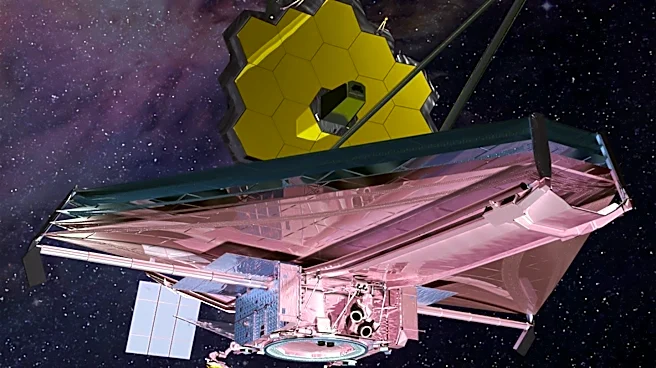
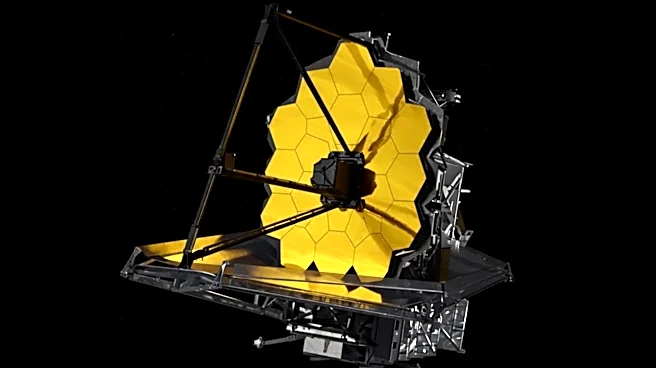
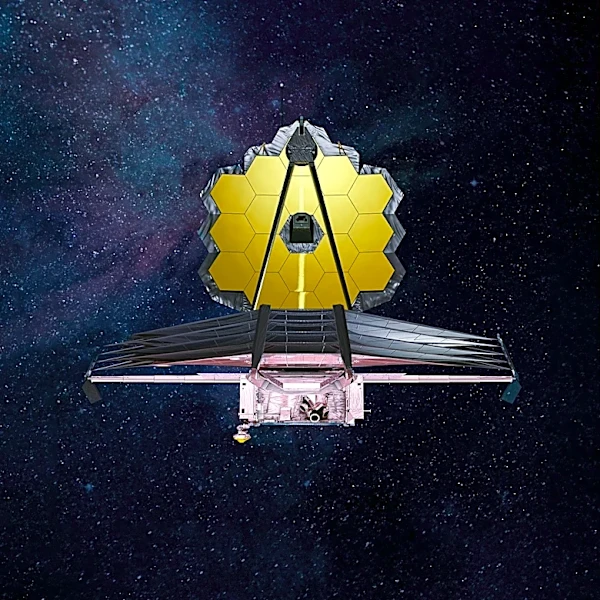
The James Webb Space Telescope (JWST) has significantly expanded the understanding of supernovae (SNe), particularly at high redshifts. Recent observations have provided insights into dust production in core-collapse supernovae (CC SNe), which may explain
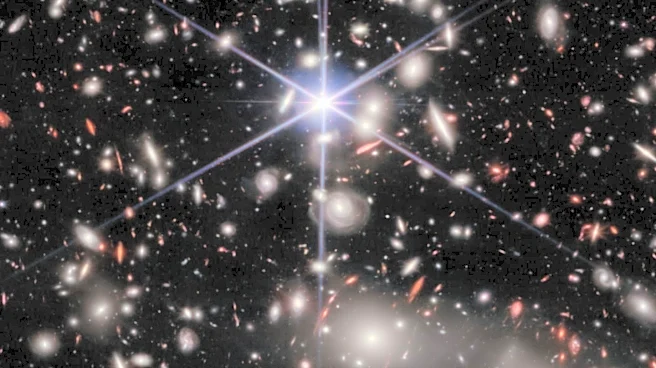
the large dust reservoirs found in the early universe. The JWST has also enabled the first mid-infrared nebular phase spectroscopy for Type Ia supernovae, offering a promising avenue for understanding their progenitor systems and implications for cosmology. At higher redshifts, the JWST has contributed to cosmological measurements, including two new measurements of the Hubble Constant (H0) using strongly lensed SNe. It has also provided constraints on redshift-dependent Type Ia SN luminosity biases, which are crucial for future dark energy measurements. Notably, SN Eos, a doubly-imaged, strongly lensed transient, is the highest-redshift SN (z=5.13) yet spectroscopically classified, providing detailed insights into stellar populations in the early universe. The telescope is now capturing the transition from molecular gas to solid grains, offering a clearer view of how newly exploded stars seed their environments with dust.
Why It's Important?
The advancements made possible by the JWST are critical for refining cosmological models and understanding the evolution of the universe. By providing unprecedented detail on supernovae, especially at high redshifts, scientists can better understand the processes that formed the first stars and galaxies. The ability to study dust production in CC SNe helps explain the presence of dust in the early universe, which was previously a puzzle. Improved understanding of Type Ia supernovae progenitors is vital for their use as 'standard candles' in measuring cosmic distances and the expansion rate of the universe. More accurate H0 measurements and constraints on luminosity biases will significantly impact dark energy research, a fundamental aspect of modern cosmology. The detailed study of distant SNe like SN Eos offers rare insights into the stellar populations that existed in the universe's infancy, shedding light on the conditions and processes that shaped the cosmos we observe today.
What's Next?
Future observations with the JWST are expected to further refine H0 measurements, potentially making a significant statement about the H0 tension in the near future. The growing sample of z > 2 Type Ia SNe observed by JWST should enable constraints on luminosity biases to below the level of intrinsic SN Ia dispersion, which will be crucial before the Roman Space Telescope becomes operational. Continued observations of galaxy clusters are anticipated to reveal additional extremely high-redshift SNe with remarkable detail, similar to SN Eos. These ongoing efforts will provide more data to study stellar populations in the early universe and further our understanding of supernova phenomena. The JWST's capabilities will continue to be leveraged for deep, high-resolution, mid-infrared imaging and spectroscopy, pushing the boundaries of supernova science.
Beyond the Headlines
The JWST's contributions extend beyond specific supernova discoveries, representing a paradigm shift in observational astronomy. Its ability to peer back in time to the early universe allows scientists to witness cosmic events that were previously inaccessible, fundamentally altering our understanding of cosmic evolution. The detailed study of dust formation from supernovae has implications for the origins of planetary systems, as dust grains are the building blocks of planets. The precision of JWST's measurements also highlights the increasing sophistication of astronomical instrumentation and data analysis techniques. This new era of supernova science, driven by JWST, is not just about cataloging events but about unraveling the fundamental physics governing the universe, from stellar life cycles to the nature of dark energy, and potentially reshaping our cosmic narrative.