





What's Happening?
University of Arizona researchers have published a new study in Nature Climate Change, revealing that global dryland ecosystems are becoming increasingly unstable despite a persistent 'greening' trend. Analyzing over four decades of satellite data, the
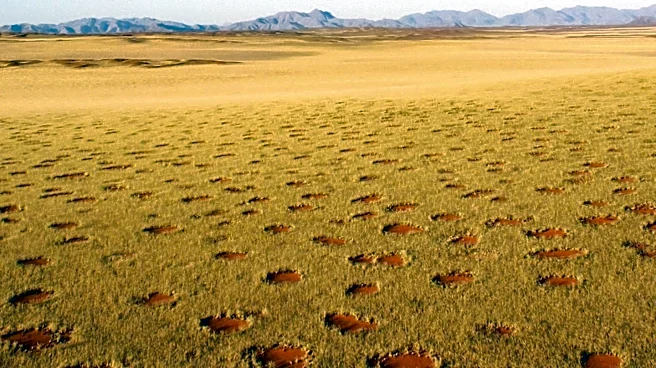
team, led by doctoral student Wen Zhang, found that rising atmospheric carbon dioxide levels stimulate plant growth during wet years. However, this increased vegetation becomes more vulnerable during subsequent dry years, leading to severe year-to-year swings in plant productivity. Approximately 80% of global drylands are experiencing this escalating instability, where vegetation activity is significantly higher in wet periods but suffers more severely during droughts. This 'boom-and-bust' dynamic suggests that while plants may become more water-efficient under high CO2, larger plant structures require more resources, making them more sensitive to moderate droughts. The study also highlights that current global vegetation models fail to capture this increased year-to-year variability, overestimating the stability of dryland ecosystems.
Why It's Important?
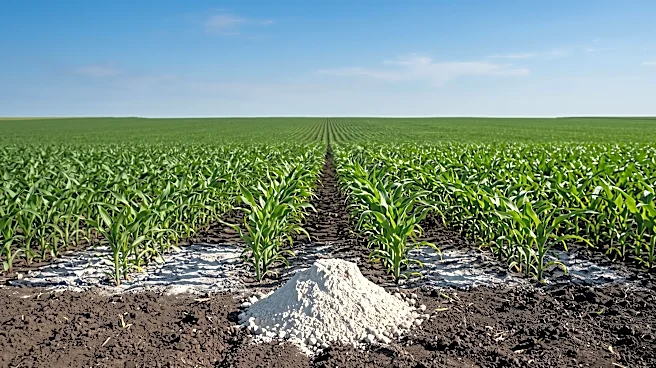
This research has significant implications for U.S. agriculture, particularly in rain-fed farming regions like the American Southwest. The escalating year-to-year volatility in dryland plant productivity will likely necessitate a heavier reliance on artificial irrigation to maintain agricultural output, increasing operational costs and water demand in already water-stressed areas. For livestock production and rangeland management, the unpredictability of pasture forage production poses a substantial challenge, disrupting ranchers' planning and potentially impacting livelihoods. Beyond agriculture, the study suggests that this 'flickering' effect in plant productivity could be an early indicator of broader ecological changes, signaling that dryland systems are under stress and losing resilience. The failure of leading global vegetation models to accurately represent this instability means that current climate change projections for these ecosystems may be fundamentally flawed, hindering effective long-term planning and adaptation strategies for regions heavily dependent on dryland resources.
What's Next?
The findings call for immediate attention to improve the accuracy of global vegetation models. Researchers will likely focus on incorporating the observed 'boom-and-bust' dynamic into future models to provide more reliable climate change projections for dryland ecosystems. This will involve further investigation into the precise mechanisms driving this instability, particularly the interplay between increasing atmospheric carbon dioxide and rainfall variability. For policymakers and agricultural stakeholders in regions like the American Southwest, the study underscores the urgent need to develop more robust water management strategies and support systems for rain-fed agriculture and rangeland management. This could include investing in drought-resistant crops, advanced irrigation technologies, and flexible land-use policies to mitigate the economic and ecological impacts of increased variability. The scientific community will also need to explore the long-term ecological consequences of this instability, potentially leading to new research on ecosystem tipping points and resilience in dryland environments.
Beyond the Headlines
The study's revelation of escalating instability in drylands, despite a 'greening' trend, uncovers a critical blind spot in our understanding of climate change impacts. The seemingly positive 'greening' masks a deeper vulnerability, highlighting the complex and often counterintuitive ways ecosystems respond to environmental shifts. This challenges the simplistic narrative of increased plant growth being universally beneficial, revealing a trade-off where short-term gains in biomass can lead to long-term fragility. Ethically, this raises questions about our responsibility to accurately model and communicate climate risks, especially when current models may be providing an overly optimistic view of ecosystem stability. Culturally, the findings could influence how societies perceive and adapt to climate change, moving beyond a focus on average trends to a greater appreciation of extreme variability and its disruptive potential. The long-term shift could be towards a more nuanced approach to environmental management, prioritizing resilience and adaptive capacity over mere productivity, particularly in vulnerable dryland regions that support a significant portion of the global population.