





What's Happening?
NASA's SPHEREx mission has successfully mapped interstellar ice within giant molecular clouds in the Milky Way galaxy. These clouds, spanning over 600 light-years, are regions where gas and dust collapse to form stars. The study, published in The Astrophysical
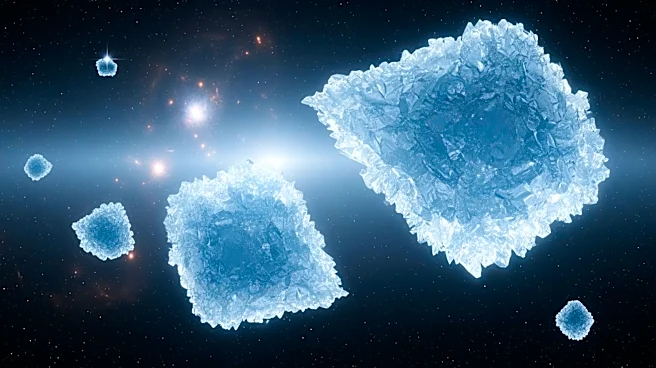
Journal, highlights that the densest regions of ice coincide with the densest regions of dust, which protect the ice from ultraviolet radiation emitted by newborn stars. This discovery supports the hypothesis that interstellar ice forms on the surface of tiny dust particles, potentially delivering a massive water supply to new solar systems.
Why It's Important?
The mapping of interstellar ice by SPHEREx is significant as it provides insights into the origins of water and life in the universe. Understanding the distribution and composition of these icy molecules can help scientists explore the chemical processes that deliver essential molecules for life to newly formed planets. This research could have implications for the study of planet formation and the potential for life in other solar systems, offering a deeper understanding of cosmic evolution and the conditions necessary for life.
What's Next?
The SPHEREx mission will continue to provide valuable data on the components of our galaxy, aiding in the exploration of star and planet formation processes. Future observations will enhance our understanding of the interstellar medium and the chemical processes that support life. The mission's findings may influence future astronomical research and the search for habitable planets, as scientists use this data to refine models of cosmic evolution and the conditions that foster life.