


What's Happening?
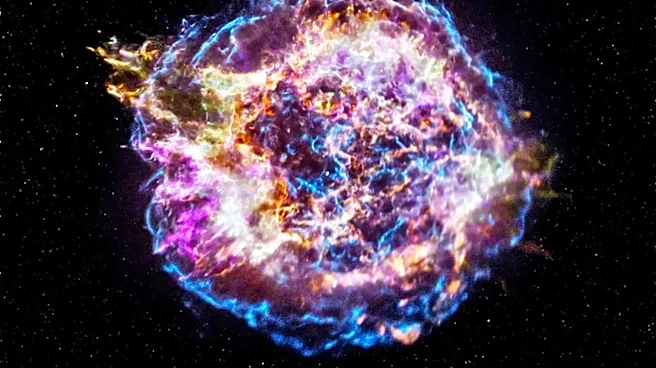
Visible-light observations of the Ibn-type supernova SN 2023uqf have revealed conditions that could accelerate cosmic rays to PeV energies. Researchers from RIKEN used a radiation-hydrodynamics model to analyze the shock radius, velocity, and surrounding
gas density, linking these to the production of high-energy neutrinos. The 442 TeV neutrino event detected by IceCube falls within the predicted range, suggesting SN 2023uqf as a potential source. However, the expected detection count is low, indicating the need for further investigation.
Why It's Important?
Understanding the sources of high-energy neutrinos is crucial for advancing astrophysics and particle physics. The study of SN 2023uqf provides insights into the mechanisms of cosmic ray acceleration and neutrino production. Identifying supernovae as potential sources of PeV neutrinos could enhance our knowledge of cosmic phenomena and contribute to the development of new models in astrophysics. This research also highlights the importance of multi-wavelength observations in studying transient cosmic events.
What's Next?
Researchers plan to explore a wider range of supernovae and refine their models to better understand the conditions for neutrino production. Future studies may focus on nearby objects to improve detection rates and validate the findings. The integration of neutrino observations with other wavelengths could provide a comprehensive view of cosmic ray acceleration processes, advancing the field of high-energy astrophysics.