


What's Happening?
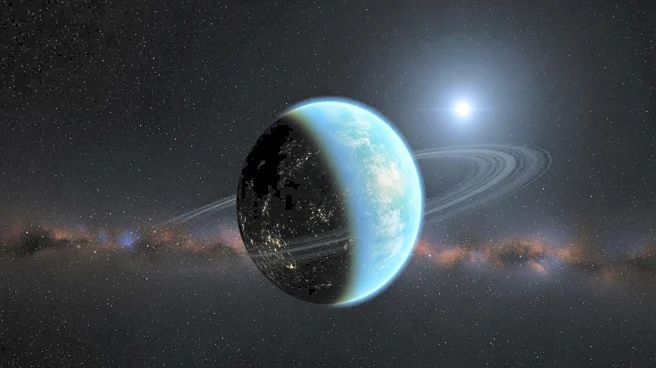
Astronomers have confirmed the existence of a 'free-floating' exoplanet, a rogue planet not bound to any star, located approximately 10,000 light-years from Earth. This discovery was made using gravitational microlensing, which allows scientists to detect
planets by observing the distortion of light from distant stars. The rogue planet, roughly the size of Saturn, adds to the growing evidence that such planets may be abundant in the Milky Way. Theoretical studies suggest that rogue planets could be more numerous than stars in our galaxy, offering insights into planetary formation and dynamics.
Why It's Important?
The confirmation of a rogue planet's existence challenges traditional views of planetary systems and suggests that the galaxy may be teeming with such planets. Understanding rogue planets can provide valuable information about the processes that lead to planet formation and the conditions that cause planets to become unbound from their stars. This discovery could impact future astronomical research and the development of technologies to detect and study these elusive worlds. It also highlights the potential for new discoveries in the field of exoplanet research, which could reshape our understanding of the universe.
What's Next?
Future space telescopes, such as NASA's Nancy Grace Roman Space Telescope and China's Earth 2.0 satellite, are expected to enhance the detection of rogue planets. These telescopes will scan large areas of the sky, potentially uncovering more free-floating planets and providing further insights into their characteristics and distribution. Continued research into rogue planets will focus on understanding their formation, evolution, and potential for hosting life. The scientific community will likely explore new methods to study these planets, contributing to the broader field of exoplanetary science.