
What's Happening?
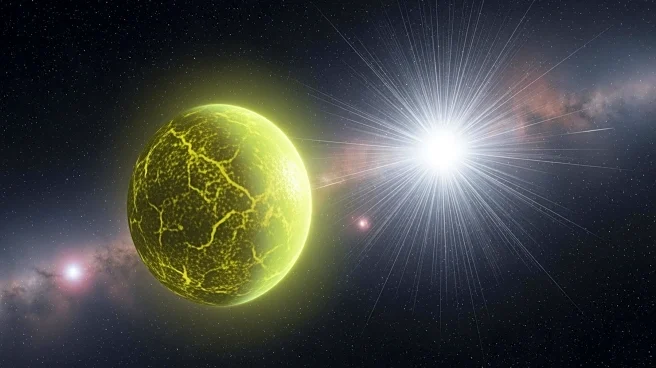
Scientists have discovered an exoplanet, PSR J2322-2650b, with a unique lemon-like shape due to the gravitational forces of a nearby pulsar. Located 750 light-years from Earth, this planet is stretched
laterally and squeezed centrally, deviating from the typical spherical shape of planets. The pulsar, a remnant of a supernova, exerts strong gravitational and energy forces, pulling matter from the planet. The planet's atmosphere, primarily composed of helium and carbon, lacks common elements like oxygen and nitrogen. This unusual composition suggests the presence of soot-like clouds and possibly diamond-like structures deep within the planet.
Why It's Important?
The discovery of PSR J2322-2650b challenges existing planetary models and provides new insights into the effects of extreme gravitational forces on planetary bodies. The planet's unique shape and atmospheric composition offer a rare opportunity to study the interactions between pulsars and their planetary companions. This could lead to a better understanding of the formation and evolution of planets in extreme environments, potentially influencing future research on exoplanets and their habitability. The findings also highlight the capabilities of the James Webb Space Telescope in observing distant and unusual celestial objects.
What's Next?
Further research is needed to explore the planet's atmospheric composition and internal structure. Scientists may conduct additional observations using the James Webb Space Telescope and other instruments to gather more data on the planet's characteristics. This could involve studying similar systems to determine if such configurations are common or unique. The findings may also prompt theoretical work to develop new models of planet formation and evolution in extreme gravitational environments.