



What's Happening?
NASA has announced its $10 billion Commercial Lunar Payload Services (CLPS) 2 program, a 10-year, multiple-award, indefinite-delivery, indefinite-quantity master contract. Eight companies, including Blue Origin, Firefly Aerospace, Intuitive Machines,
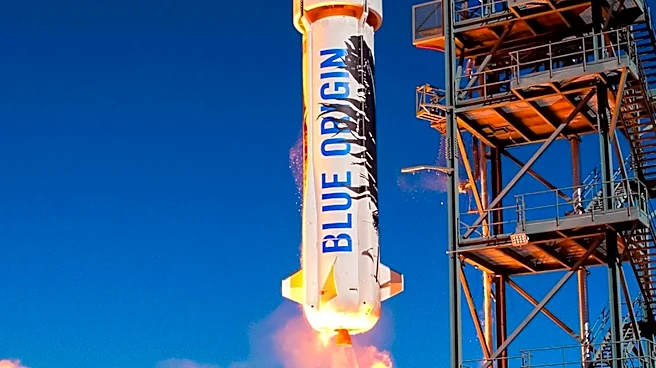
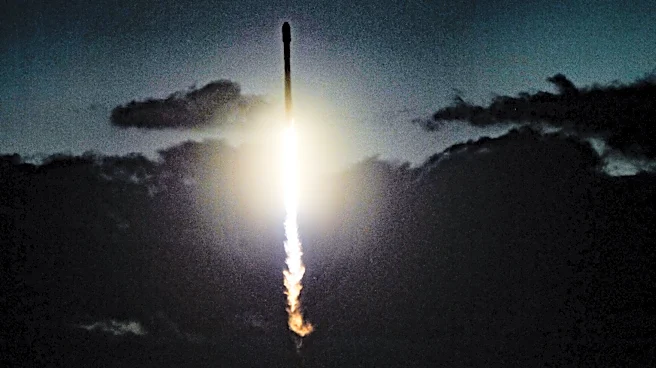
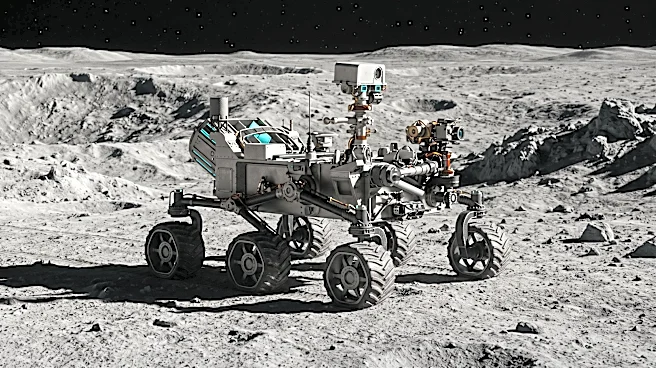
iSpace US, Lockheed Martin Space, Northrop Grumman Space Systems, SpaceX, and Voyager Technologies, are now eligible to compete for cargo runs to the lunar surface. The program aims to support NASA's Moon Base initiative by increasing the cadence of commercial deliveries and focusing on larger cargo landers and critical infrastructure. As part of this initiative, NASA is moving forward with PROMISE (Polar Rover for Observation, Mapping, and In-Situ Exploration), a six-wheeled, nuclear-powered rover. Blue Origin has secured a $94 million base contract, with an option for an additional $140 million, to deliver PROMISE to the lunar South Pole using its Mark 1 lander, targeting a late-2028 launch for an 18-month mission.
Why It's Important?
NASA's $10 billion CLPS 2 program marks a significant commitment to establishing a permanent Moon Base and underscores the agency's strategy of leveraging commercial partners for lunar logistics. By involving eight diverse companies, NASA aims to foster competition, innovation, and efficiency in delivering payloads to the Moon. This approach is crucial for the Artemis program's goal of returning humans to the Moon and sustaining a long-term presence. The PROMISE nuclear rover mission is particularly important as it will characterize the lunar South Pole, a region believed to contain water ice essential for future human missions. The rover's nuclear power source will enable it to operate through the long lunar night and in permanently shadowed regions, providing critical data for resource utilization. This commercial model not only reduces costs and accelerates timelines but also stimulates growth and technological advancement within the U.S. space industry, creating new opportunities for businesses and skilled labor.
What's Next?
The CLPS 2 program will see the eight selected companies competing for individual task orders, which will involve managing, building, and operating landers to transport NASA's science, technology, and infrastructure payloads. The first CLPS 2 task orders are expected to focus on cargo runs and technology demonstrations to de-risk landing, power, and communications ahead of crewed Artemis missions. NASA plans a separate solicitation for fully integrated power systems in early 2027, indicating ongoing opportunities for vendors. Blue Origin's delivery of the PROMISE nuclear rover is targeted for late 2028, marking a key step in understanding the lunar South Pole's resource potential. Additionally, NASA has issued six task orders worth approximately $1.3 billion under its Venture-Class Acquisition of Dedicated and Rideshare (VADR) launch contract, further expanding commercial involvement in lunar logistics and testing navigation and cargo transfer capabilities.
Beyond the Headlines
The CLPS 2 program and the PROMISE mission highlight a strategic shift towards a more sustainable and resource-focused approach to lunar exploration. The emphasis on a nuclear-powered rover for the South Pole underscores the critical importance of water ice for future human settlements, as it can be converted into drinking water, breathable oxygen, and rocket fuel. This focus on in-situ resource utilization (ISRU) is a game-changer for long-duration space missions, potentially reducing the cost and complexity of resupply from Earth. The commercial model adopted by NASA, where private companies handle the logistics, allows the agency to concentrate on scientific research and the development of advanced technologies. This collaborative ecosystem between government and private industry is not only accelerating lunar exploration but also laying the groundwork for a future lunar economy, with implications for international cooperation, space law, and the long-term human presence beyond Earth.