


What's Happening?
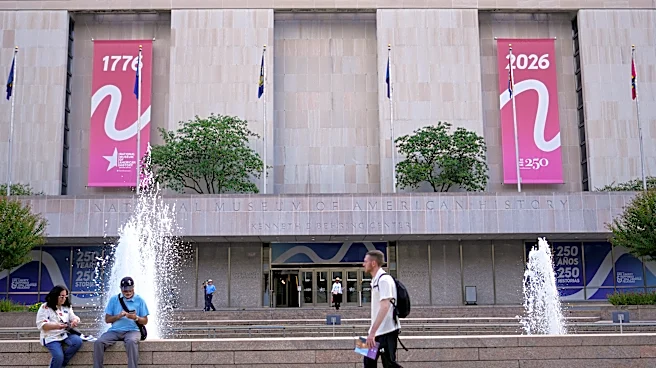
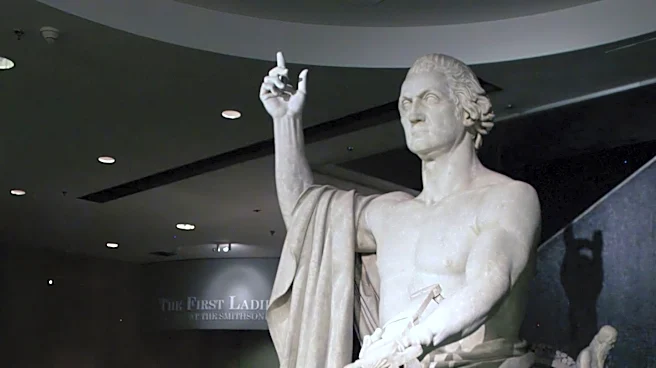
President Trump has publicly requested that the Smithsonian Institution install a colossal statue of George Washington outside the National Museum of American History and create a special exhibit honoring the nation's first president. In social media
posts, President Trump specifically asked for an exhibit to run from now until February 22, 2032, marking the 300th anniversary of Washington’s birth. He also requested that an 11-foot statue of Washington, previously featured at the Freedom 250 IndyCar race, be placed in the museum's Flag Hall for Constitution Day on September 17. Furthermore, President Trump proposed replacing the existing 'Infinity' sculpture by Jose de Rivera, installed in 1967, with a 30-foot statue of Washington. He expressed concern that the museum currently omits Washington's crossing of the Delaware River from its narrative and suggested replacing the 'Center for Restorative History' with a 'Center for American Heroes.'
Why It's Important?
President Trump's directive highlights a broader effort to reshape the historical narrative presented by national institutions. His focus on George Washington and 'American Heroes' reflects a desire to emphasize traditional interpretations of U.S. history, potentially shifting away from initiatives that explore diverse or previously excluded historical perspectives. This move could influence how millions of museum visitors, including students and tourists, perceive foundational American figures and events. The request also raises questions about the autonomy of the Smithsonian Institution, which operates independently of the executive branch and is overseen by a Board of Regents. The potential changes could spark debate among historians, educators, and the public regarding the role of national museums in interpreting history and the balance between celebrating historical figures and presenting a comprehensive, nuanced account of the past.
What's Next?
The Smithsonian Institution's Board of Regents, which includes Vice President JD Vance, Supreme Court Chief Justice John Roberts, lawmakers, and citizens, will likely consider President Trump's requests. It is unclear whether President Trump has the authority to mandate these changes, as the Smithsonian operates outside direct executive control. However, President Trump has previously indicated his intention to influence the Smithsonian through an executive order targeting funding for programs deemed to advance 'divisive narratives' or 'improper ideology.' A lengthy report from the White House earlier this year also criticized the institution for not adequately highlighting Washington and other founders. The recent announcement of Lonnie Bunch, the institution's top leader, stepping down at the end of the year, adds another layer of complexity to the situation, as new leadership may face pressure to address these demands. Public and academic reactions to President Trump's proposals are also anticipated.
Beyond the Headlines
This initiative by President Trump extends beyond a simple request for statues; it represents a significant cultural and ideological battle over the interpretation of American history. By advocating for a 'Center for American Heroes' and criticizing the museum's current narrative, President Trump is challenging the institution's approach to historical storytelling, particularly its recent efforts to include more diverse and critical perspectives. This could lead to a broader re-evaluation of how national museums balance historical accuracy with public perception and political influence. The emphasis on monumental figures like George Washington, while historically significant, could be seen by some as a move to simplify complex historical contexts and potentially overshadow narratives of marginalized groups. The debate over these changes could reflect deeper societal divisions regarding national identity, historical memory, and the role of public institutions in shaping collective understanding.