






What's Happening?
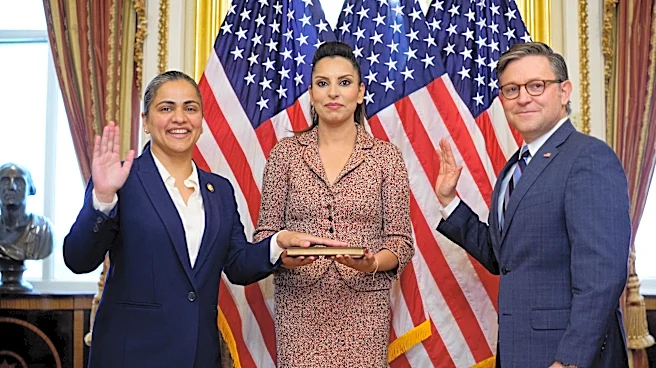
Judge Daniel Traynor, a distinguished alumnus of the University of North Dakota (UND) School of Law, was officially sworn in as the newest member of the United States Court of Appeals for the Eighth Circuit. The investiture ceremony took place on Thursday,
October 29, in a special session held at the UND School of Law’s VandeWalle Courtroom. The Eighth Circuit holds jurisdiction over cases in North Dakota, South Dakota, Minnesota, Iowa, Nebraska, Missouri, and Arkansas. Judge Traynor fills the seat of fellow UND Law alumnus Judge Ralph R. Erickson, who is retiring. Prior to this appointment, Judge Traynor served as a justice of the United States District Court for the District of North Dakota from 2020 to 2026 and practiced insurance law and business litigation in Devils Lake.
Why It's Important?
Judge Traynor's appointment to the U.S. Court of Appeals for the Eighth Circuit is a significant judicial development, bringing a new perspective to a federal court that impacts a wide region of the United States. His background, including his experience on the District Court and in private practice, will shape his contributions to federal jurisprudence. The ceremony's location at UND Law School, rather than a federal courthouse, underscores his deep ties to the institution and his family's legacy in the legal profession, with five family members, including his father, grandfather, and brothers, being UND Law alumni. This appointment ensures continued representation from North Dakota on a crucial federal appellate court, influencing legal interpretations and decisions across seven states.
What's Next?
As a new member of the Eighth Circuit, Judge Traynor will begin hearing cases and contributing to the court's decisions, which often set precedents for lower federal courts within its jurisdiction. His presence on the bench will influence legal outcomes in a wide array of federal cases, from constitutional law to business disputes. His remarks at the ceremony, emphasizing the need for empathetic and nuanced attorneys in an era of rapidly advancing artificial intelligence, suggest his judicial philosophy may incorporate a human-centric approach to legal interpretation. Furthermore, his call for more lawyers in rural areas and tribal nations highlights a critical access-to-justice issue that he may continue to champion in his new role.
Beyond the Headlines
Judge Traynor's investiture highlights the enduring legacy of legal education at institutions like UND Law School in shaping the federal judiciary. His emphasis on human empathy in the legal profession, particularly in the context of artificial intelligence, raises profound questions about the future of law and justice. As AI technologies become more integrated into legal processes, the role of human judgment and compassion, as advocated by Judge Traynor, becomes increasingly vital. His personal story, including the cancellation of his law school graduation due to the Red River Flood of 1997 and his district court investiture due to the COVID-19 pandemic, adds a unique human element to his judicial journey, underscoring resilience and dedication to public service despite unforeseen challenges.