







What's Happening?
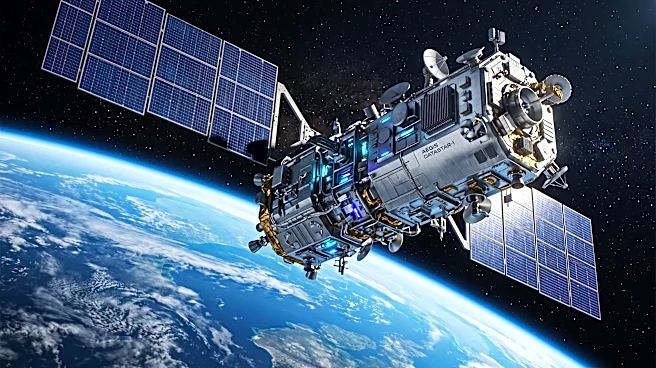
Orbital, a Los Angeles-based company, has secured a deal worth up to $20 million with satellite autonomy startup Orca Aerospace. This partnership will integrate Orca's onboard autonomy software into Orbital's planned fleet of data center satellites. The
software is designed to act as an autonomous navigator, connecting each satellite's flight software to Orbital's ground control. This will enable satellites to independently handle maneuvers, tasks, and fault responses, reducing the need for extensive human intervention. According to Orca Aerospace CEO and cofounder Jacob Ososke, this technology is crucial for collision avoidance and for Orbital to scale its operations safely. The software will operate in a 'shadow mode' initially, sending telemetry for human review, and then gradually gain full autonomy. An onboard AI model will suggest next steps, which a rules-based program will convert into commands, and a safety kernel will verify these commands against mission rules before execution. The companies anticipate this collaboration will be a long-term partnership, with Orbital's data centers potentially providing computing power for Orca's platform, allowing other spacecraft to connect to Orbital satellites instead of ground stations.
Why It's Important?
This collaboration signifies a major advancement in satellite autonomy, particularly for the rapidly growing low Earth orbit (LEO) satellite market. The increasing congestion in LEO, especially in sun-synchronous orbits where many data-center constellations are planned, necessitates sophisticated collision avoidance capabilities. By enabling satellites to manage their own navigation and operations, Orca's software can significantly enhance the safety and efficiency of large satellite fleets. This reduces operational costs by minimizing the need for large human operator teams and allows for greater scalability. The ability for other spacecraft to connect to Orbital's satellites for coordination, rather than relying solely on ground stations, could also streamline space traffic management and data sharing among operators. This development is critical for the future of space infrastructure, as it addresses key challenges related to operational complexity and safety in an increasingly crowded orbital environment, impacting both commercial and defense applications.
What's Next?
Under the letter of intent, Orbital will pay Orca an integration fee and a license fee for each satellite utilizing Orca's software. Orca will integrate its software with the flight software from Reflex Aerospace, Orbital's bus partner. The software is slated for its first flight on Orbital-1 in 2028, with potential earlier testing on Orbital's July 2027 Pathfinder mission. Orbital plans an aggressive expansion of its fleet, aiming for 10 satellites in 2029, 100 in 2030, and 1,000 in 2031. This rapid scaling will heavily rely on the successful implementation and performance of Orca's autonomy software. The companies intend to keep Orca's coordination protocols open, facilitating data sharing with other operators, which could lead to broader adoption of autonomous navigation standards in the space industry.
Beyond the Headlines
The move towards highly autonomous satellite operations, as exemplified by the Orbital-Orca partnership, has profound implications for the future of space exploration and utilization. It represents a 'paradigm shift' in how space assets are managed, moving from human-intensive control to AI-driven decision-making. This shift could enable more complex and targeted missions, potentially reducing the cost and increasing the accessibility of space operations. However, it also raises questions about the reliability and security of AI systems in critical space infrastructure. The concept of 'open coordination protocols' suggests a future where satellite networks are more interconnected and collaborative, potentially forming a 'highway to the moon and back' as described by Winnie Lai of Auriga Space in a related context. This could lead to new forms of space commerce and defense, but also necessitates robust regulatory frameworks and international cooperation to manage the risks associated with increased autonomy and interconnectedness in orbit.