


What's Happening?
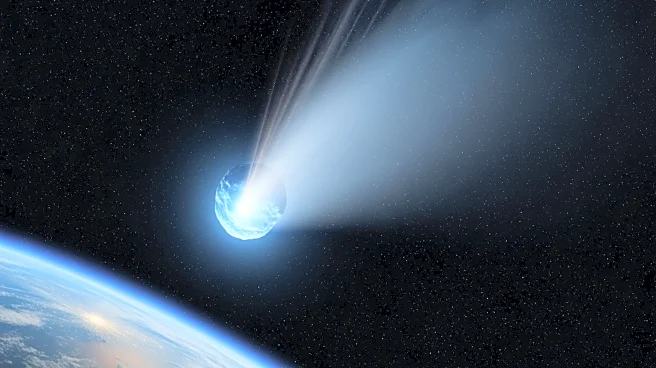
The interstellar comet 3I/ATLAS is approaching its closest point to Earth, expected early on December 19, 2025. Although it will remain about 1.8 astronomical units away, this proximity is sufficient to trigger extensive observation efforts by astronomers
worldwide. The comet, only the third interstellar object confirmed to pass through our solar system, is being closely monitored for scientific study. Various livestreams and viewing guides are available for those interested in observing the event, though a telescope is required as the comet is not visible to the naked eye. The comet's approach has generated significant interest due to its unique origin and the opportunity it presents to study interstellar materials.
Why It's Important?
The approach of 3I/ATLAS is crucial for scientific research, as it provides a chance to study an object from another star system. This can offer valuable insights into the composition and formation of celestial bodies beyond our solar system. The data collected during this event could enhance our understanding of the universe and inform future space exploration missions. Additionally, the comet's behavior, including its non-gravitational acceleration due to outgassing, is of particular interest to scientists studying cometary physics.
What's Next?
After its closest approach, 3I/ATLAS will continue its journey out of the solar system. Observations will persist as long as the comet remains within reach of telescopes, with scientists aiming to gather comprehensive data on its properties and trajectory. The event highlights the importance of international collaboration in space research and the potential for future discoveries as technology and observation techniques continue to advance.