




What's Happening?
The European Investment Bank (EIB) has signed two new agreements to bolster Poland's energy security and economic competitiveness. One agreement involves PLN 85 million (approximately €20 million) in financing for the National Centre for Nuclear Research
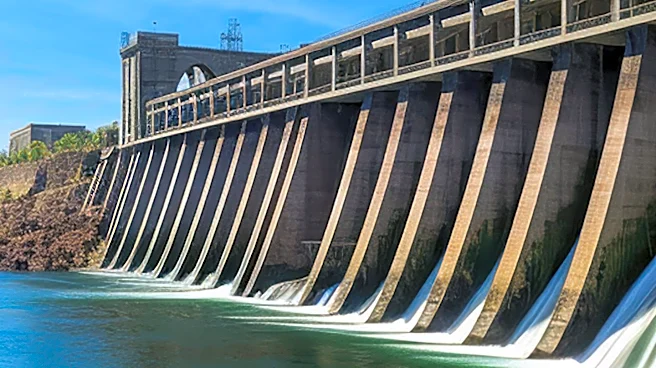
(NCBJ). This funding, provided under the EIB's TechEU program, will support the construction of advanced scientific infrastructure, including a neutron laboratory (MNL Maria Neutron Laboratory) and enhancements to the Polish Free Electron Laser (PolFEL 1.1). These facilities will facilitate research and development in physics, materials engineering, and medicine, particularly for renewable energy and extreme operating conditions. The total cost for these three NCBJ projects exceeds PLN 460 million, with co-financing from the National Recovery and Resilience Plan. Separately, EIB Advisory has initiated cooperation with Wody Polskie, Poland's state water holding, to develop its hydropower capacity, focusing on two southern regions traditionally reliant on fossil fuel production. This advisory agreement aims to advance renewable energy development.
Why It's Important?
These EIB agreements are crucial for Poland's strategic shift towards greater energy independence and a knowledge-based economy. The investment in NCBJ's nuclear research infrastructure is significant for advancing scientific capabilities in areas like nuclear energy, advanced materials, and medical applications, which are vital for technological autonomy and economic competitiveness. By supporting the development of measurement techniques for materials used in renewable energy sources and batteries, the EIB is directly contributing to the broader European goal of a green transition. The collaboration with Wody Polskie to expand hydropower capacity in fossil fuel-dependent regions addresses both energy security and climate action, helping to diversify Poland's energy mix and reduce reliance on traditional energy sources. This dual approach of investing in cutting-edge research and renewable energy infrastructure underscores a comprehensive strategy to enhance national resilience and align with EU policy objectives for climate and innovation.
What's Next?
The financing for the National Centre for Nuclear Research will proceed with the construction of the neutron laboratory and the enhancement of the Polish Free Electron Laser, enabling groundbreaking research in various scientific fields. The EIB's TechEU program, under which this financing is granted, aims to unlock €250 billion in investments across Europe by the end of 2027 in strategic areas such as artificial intelligence, biotechnology, security, defense, and clean energy, indicating further potential investments in similar projects. The advisory agreement with Wody Polskie will involve analyzing major hydropower investments in the Silesia and Lesser Poland regions, with technical, financial, and environmental assistance provided under the TARGET program. This two-year collaboration is expected to lead to the development of new hydropower plants, increasing the share of renewable sources in Poland's energy mix and supporting a more resilient and sustainable economy.
Beyond the Headlines
The EIB's support for Poland's nuclear research and hydropower initiatives highlights a broader European strategy to foster technological autonomy and energy security. By investing in advanced scientific infrastructure, the EIB is not only promoting innovation but also strengthening Europe's position in critical technological domains, reducing reliance on external actors. The focus on regions traditionally dependent on fossil fuels for hydropower development also addresses the social and economic challenges of a just transition, ensuring that communities are not left behind in the shift to cleaner energy. This layered approach, combining national institutions with European-level financing and expertise, demonstrates a model for tackling complex challenges like climate change and economic competitiveness. The emphasis on research and development in nuclear energy also signals a potential long-term shift in energy policy, recognizing nuclear power's role in achieving carbon neutrality and energy independence.