







What's Happening?
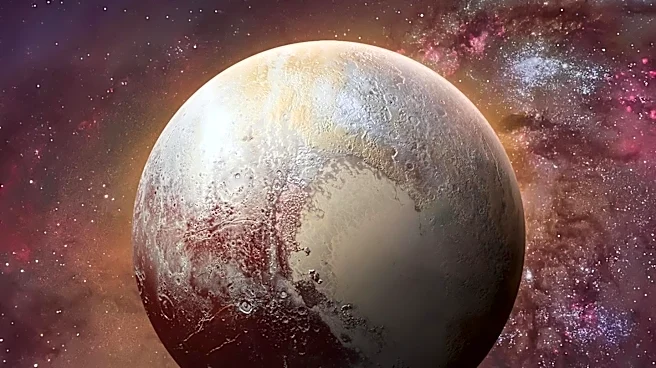
Astronomers have discovered a giant planet, WD1856b, that has survived the death of its sun, a white dwarf, located about 80 light-years from Earth. This planet, similar in size to Jupiter, orbits a star roughly the size of Earth. The discovery was made
using NASA's James Webb Space Telescope, which analyzed the planet's atmosphere, revealing methane and high-altitude hazes. This marks the first time scientists have characterized the atmosphere of a planet orbiting a dead star. The findings suggest that planets can survive the final stages of a star's life cycle, potentially widening the possibilities for habitable planets in the universe.
Why It's Important?
The survival of WD1856b challenges existing theories about planetary systems' fates after their host stars die. This discovery could reshape our understanding of the solar system's future, as it suggests that planets might endure beyond the death of their stars. The research provides a new perspective on the potential habitability of planets orbiting stellar remnants, which could have implications for the search for life beyond Earth. The study also highlights the dynamic nature of planetary systems and the possibility of planets migrating closer to their stars over time.
What's Next?
Future research will likely focus on further analyzing the atmospheres of planets orbiting white dwarfs to understand their composition and potential habitability. Scientists may also explore the gravitational interactions that could cause planets to migrate closer to their stars. This research could lead to new insights into the long-term evolution of planetary systems and the potential for life in environments previously thought inhospitable.