



What's Happening?
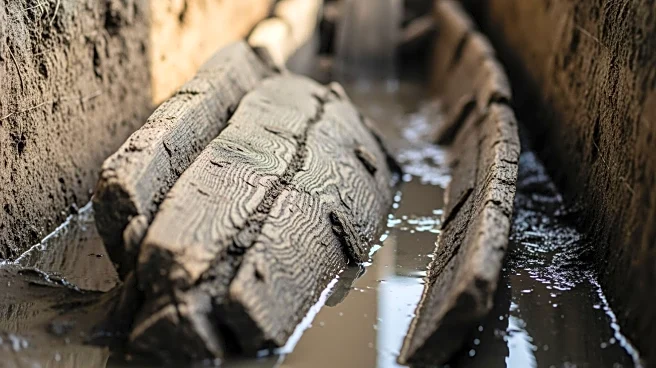
A 1,300-year-old fragment of a Viking ship was discovered during a drainage excavation project in Wijk bij Duurstede, Netherlands. The wooden beam, initially mistaken for an ordinary piece of timber, was identified by volunteer archaeologist Danny van
Basten as significant. Experts from Stichting Beheer Vikingschip and Museum Dorestad examined the 10-foot-long beam, which displayed shipbuilding marks. The artifact is believed to date back to the Carolingian period (circa 700 to 800 A.D.), a time of expanding medieval trade routes and Viking activity. The beam's age will be confirmed through ring analysis, a process expected to take several months.
Why It's Important?
The discovery of the Viking ship fragment provides valuable insights into the Carolingian period, a pivotal era in European history marked by the expansion of trade routes and Viking influence. This find could enhance understanding of Viking shipbuilding techniques and their interactions with Carolingian communities. The artifact's potential link to Viking activity underscores the historical significance of the Rhine River as a trade artery. Such discoveries contribute to the broader narrative of European maritime history and the cultural exchanges between the Vikings and other European societies.