
What's Happening?
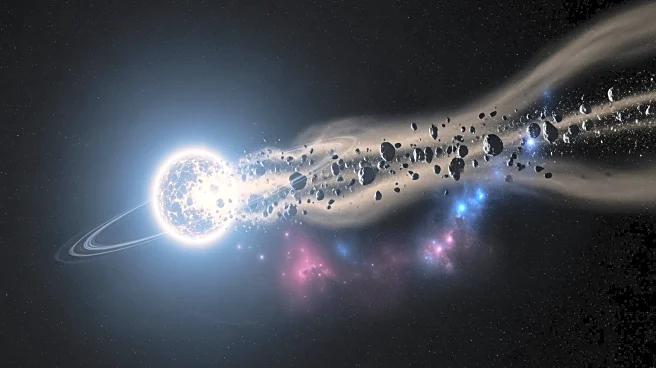
Astronomers using NASA's Hubble Space Telescope have observed the disintegration of what was initially thought to be an exoplanet in a nearby planetary system. The event, which occurred in the system surrounding the star Fomalhaut, revealed the aftermath
of massive collisions between asteroid-sized bodies. Initially, a bright point of light was assumed to be a dust-covered planet reflecting its star's glow. However, the object vanished, and a different bright source appeared nearby. Researchers realized they were witnessing glowing clouds of debris created by violent collisions. This discovery provides a rare insight into the dynamic and often violent nature of planetary systems, offering clues about how planets form and the materials involved in their creation.
Why It's Important?
The observation is significant as it provides a unique opportunity to study the processes involved in planet formation. Understanding these collisions can offer insights into the structure of asteroids, which is crucial for planetary defense programs. The findings also serve as a cautionary note for future planet searches, as large dust clouds can mimic the appearance of exoplanets, potentially misleading astronomers. This discovery underscores the importance of distinguishing between real planets and temporary dust clouds, especially as new observatories aim to directly image Earth-like planets around nearby stars.
What's Next?
Researchers plan to continue monitoring the Fomalhaut system, focusing on the new bright object, Fomalhaut cs2, to learn more about how collisions unfold in young planetary systems. Future observations will rely on the Near-Infrared Camera aboard NASA's James Webb Space Telescope, which can capture detailed color information to determine the size and composition of dust grains. This ongoing research aims to enhance our understanding of planetary formation and the frequency of such cosmic collisions.