





What's Happening?
A rose-colored meteorite, named Teghaza 001, discovered in the Sahara Desert in 2022, has been identified as a 4.1-billion-year-old fragment of Mars, according to a NASA-funded study. The nearly two-pound meteorite, found in Mali, is one of approximately
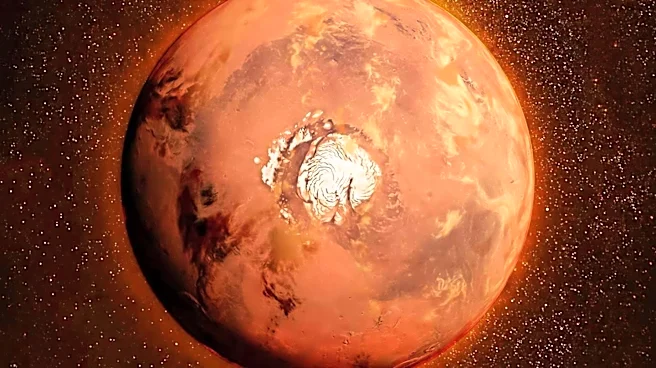
435 Martian meteorites identified on Earth. Its age makes it one of the three most ancient Martian meteorites ever found, offering a rare glimpse into the planet's early crust and formation. Yang Liu, lead author of the paper and part of NASA's Jet Propulsion Laboratory, described it as a 'Rosetta Stone for Mars' due to its unique insights into the planet's history, including how its crust formed from cooling magma and was subsequently altered by surface water.
Why It's Important?
This discovery is crucial for planetary science as it provides direct evidence of early Martian geological processes and the presence of water on the planet 4.1 billion years ago. The meteorite's unique mix of volcanic minerals, including zircon crystals, matches samples observed by NASA's Mars Reconnaissance Orbiter in Mars' southern highlands. The analysis, aided by a pioneering age-dating method developed by Francis Tissot of Caltech, revealed that the rock was altered by Martian water, suggesting a more dynamic early Martian water cycle than previously believed. This information is vital for understanding Mars' potential for past life and its atmospheric evolution, particularly how it lost water over time.
What's Next?
Further research on the Teghaza 001 meteorite is anticipated, with scientists expecting to uncover more details about Mars' early history. Lee Saper, a scientist at NASA's Ames Research Center and paper author, noted that the meteorite 'records interactions of water and rock and maybe even an imprint of the Martian atmosphere as it was losing water.' Future studies will likely delve deeper into the rock's water content and its implications for the early topography of Mars. This ongoing analysis will continue to refine our understanding of the Red Planet's geological and hydrological past, informing future Mars missions and the search for extraterrestrial life.
Beyond the Headlines
The study of ancient Martian meteorites like Teghaza 001 offers a tangible connection to another planet, allowing scientists to analyze extraterrestrial material directly on Earth. This bypasses the immense challenges and costs associated with sample return missions. The insights gained from such meteorites are fundamental to comparative planetology, helping scientists understand Earth's own formation and evolution by comparing it to Mars. The 'Rosetta Stone' analogy underscores the meteorite's potential to unlock long-held mysteries about planetary development, providing a deeper context for the origins of our solar system and the conditions necessary for life.