
What's Happening?
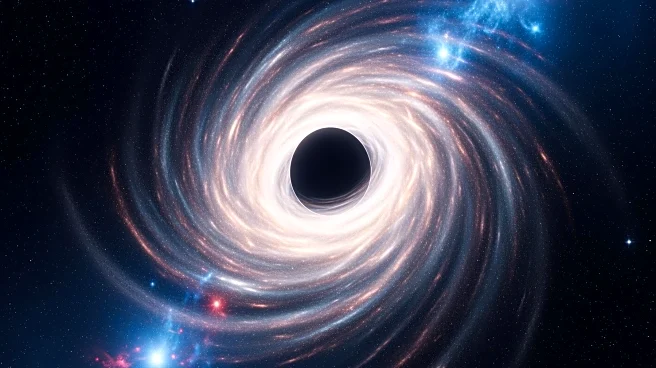
Astronomers have observed a phenomenon known as the Lense–Thirring precession, a theoretical concept first described by Austrian physicists over a century ago. This event was detected during a tidal disruption
event (TDE), where a star is consumed by a black hole, resulting in the formation of a disk and jets of matter. The study, published in Science Advances, revealed that the black hole's rapid spin caused spacetime to drag along with it, creating a vortex effect similar to a whirlpool. This observation was made by measuring the radio waves and X-rays from the disk and jets, which showed a synchronized wobbling pattern.
Why It's Important?
The confirmation of the Lense–Thirring precession provides significant evidence supporting Einstein's general theory of relativity, which predicts such 'weird' consequences. This discovery enhances our understanding of black holes and the fundamental nature of spacetime. It also opens new avenues for research into the dynamics of black holes and their interactions with surrounding matter. The ability to observe such phenomena directly is a testament to advancements in astronomical technology and methodology, potentially leading to further discoveries about the universe's most mysterious objects.
What's Next?
Future research will likely focus on observing similar phenomena in other black holes to confirm the universality of the Lense–Thirring precession. Astronomers may also explore the implications of this discovery for other theoretical predictions of general relativity. Additionally, this finding could inspire the development of new technologies and methods for studying black holes and other extreme cosmic events, further expanding our understanding of the universe.
Beyond the Headlines
This discovery highlights the ongoing relevance of theoretical physics in explaining cosmic phenomena. It underscores the importance of continued investment in space research and technology, as these efforts can lead to groundbreaking discoveries that challenge and expand our understanding of the universe. The observation of the spacetime whirlpool also serves as a reminder of the vast and largely unexplored nature of space, encouraging curiosity and exploration.