





What's Happening?
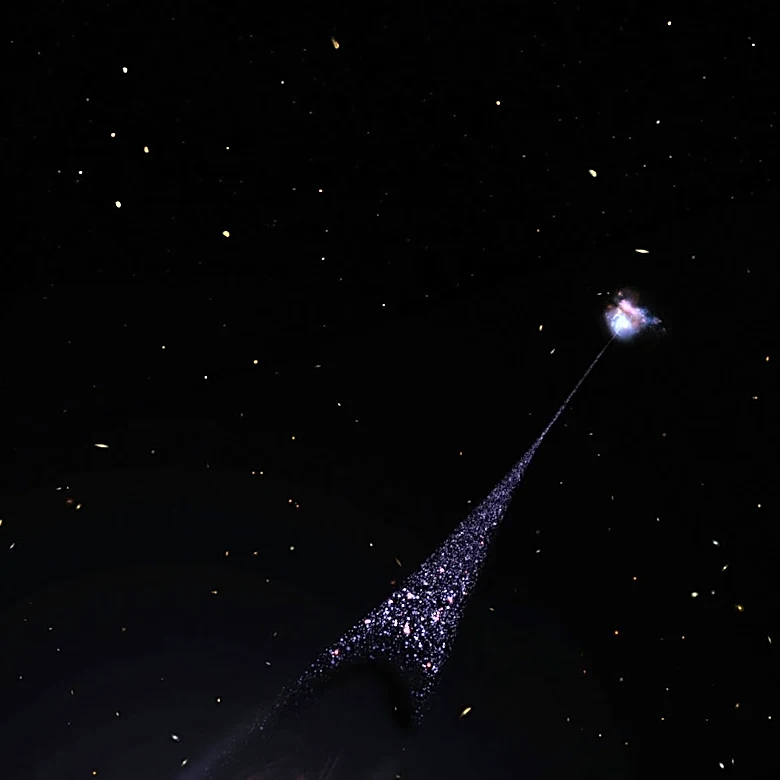
An international team of astronomers, led by researchers in Spain, the Netherlands, and Argentina, has identified the strongest candidate yet for a 'microblazar.' This object, named IRAS 18293-0941, is located approximately 12,000 light-years from Earth
within our galaxy. Microblazars are smaller versions of blazars, which are highly energetic objects powered by supermassive black holes that strip material from their host galaxies and eject it in powerful jets of particles and radiation. For an object to be classified as a blazar, one of these near-light-speed jets must point directly towards Earth. IRAS 18293-0941 is a binary system consisting of a black hole orbiting a hot, gigantic star every 11 days. Matter from the star falls into the black hole, and some of this material is expelled in two opposing jets, with one of them directed towards Earth. The study, accepted for publication in the journal Astronomy and Astrophysics, utilized various instruments, including the Calar Alto Astronomical Observatory in Spain, the European VLBI Network, the MeerKAT radio telescope array in South Africa, and archival data from the Very Large Array in New Mexico.
Why It's Important?
The identification of IRAS 18293-0941 as a potential microblazar is significant because it offers astronomers a closer view of black holes emitting powerful energy jets, which can help in understanding the behavior of these extreme cosmic objects. Microblazars are theorized to power some of the universe's most energetic processes. While blazars are typically associated with supermassive black holes at the centers of galaxies, microblazars would represent a smaller-scale, yet equally powerful, phenomenon. Observations of such objects could provide crucial insights into the mechanisms by which black holes accelerate particles to ultra-high energies and generate intense radiation. This discovery could also refine existing models of black hole physics and the evolution of binary star systems involving black holes. The study's findings contribute to a broader understanding of high-energy astrophysics and the extreme environments found in the universe.
What's Next?
The research team is currently investigating whether a specific observed area behind IRAS 18293-0941 is indeed a 'hotspot,' which is another predicted characteristic of microblazars. While IRAS 18293-0941 exhibits most of the expected microblazar features, it lacks rapid variability in brightness, which is typically amplified by the Doppler boosting effect when a jet points towards Earth. Researchers suggest that a dense cloud of gas surrounding the object might be smoothing out these rapid fluctuations. Future observations will likely focus on confirming the hotspot and further analyzing the object's variability to definitively classify it as a microblazar. Continued study of IRAS 18293-0941 and the search for other microblazar candidates will be crucial for validating the theoretical predictions and advancing our understanding of these powerful cosmic accelerators.
Beyond the Headlines
The discovery of a microblazar candidate opens new avenues for exploring the fundamental physics of black holes and their interactions with surrounding matter. The existence of such objects implies that the mechanisms driving powerful jets and high-energy emissions are not exclusive to supermassive black holes but can also occur in smaller, stellar-mass black hole systems. This could have implications for understanding the origin of cosmic rays and other high-energy phenomena observed in the universe. Furthermore, the challenges in observing microblazars, due to their short evolutionary phase, highlight the importance of advanced observational techniques and international collaboration in astronomy. The ongoing research into IRAS 18293-0941 could provide a unique laboratory for studying extreme astrophysical processes in a relatively nearby galactic environment, offering insights that might be difficult to obtain from more distant and larger blazars.