
What's Happening?
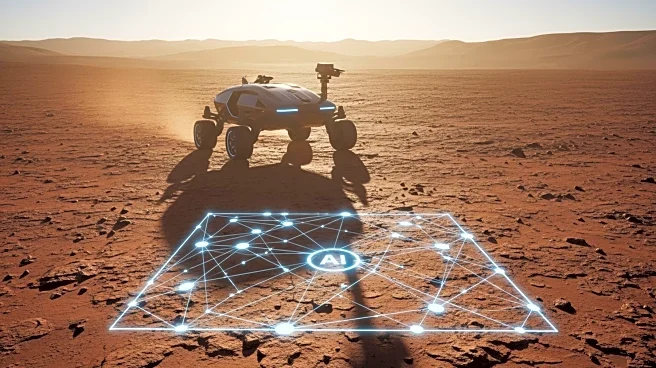
NASA has successfully demonstrated the use of generative artificial intelligence in planning the route for its Perseverance Mars rover. During a drive on December 10, 2025, the AI-planned route was compared
to the actual path taken by the rover, showcasing the potential of AI in space exploration. The AI-generated waypoints were marked with magenta circles, while the actual path was depicted with orange lines. This initiative is part of NASA's efforts to incorporate advanced technology in its missions, with the AI planning being managed by the Jet Propulsion Laboratory and the University of Arizona operating the HiRISE camera used for imaging.
Why It's Important?
The integration of AI in space missions represents a significant advancement in how NASA conducts its exploratory operations. By utilizing AI for route planning, NASA can potentially increase the efficiency and safety of rover missions on Mars. This technology could lead to more autonomous operations, reducing the need for constant human intervention and allowing for more complex missions. The success of this demonstration could pave the way for broader applications of AI in space exploration, potentially impacting future missions to other planets and celestial bodies.
What's Next?
Following the successful demonstration, NASA may continue to refine and expand the use of AI in its Mars missions. Future steps could involve more complex AI-driven tasks, such as autonomous decision-making for scientific experiments or hazard avoidance. The ongoing development of AI technologies could also influence the design and planning of upcoming missions, potentially leading to more ambitious exploration goals.