
What's Happening?
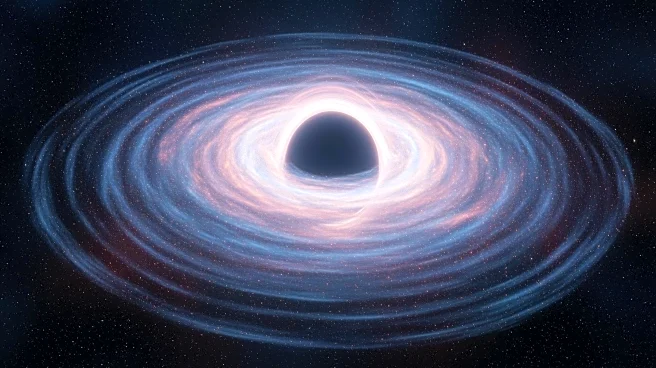
The James Webb Space Telescope (JWST) has provided the clearest view yet of a supermassive black hole's surroundings in the Circinus galaxy, located approximately 14 million light-years from Earth. A team
led by Enrique Lopez-Rodriguez from the University of South Carolina utilized specialized techniques to examine the dust-shrouded core of the galaxy. The observations revealed a dense disk of gas and dust, known as a torus, feeding the black hole, challenging previous assumptions that the intense infrared glow in active galaxies was due to powerful outflows. The study, which involved observations in July 2024 and March 2025, used a high-contrast mode of Webb to achieve unprecedented detail, effectively doubling the telescope's observational capacity.
Why It's Important?
This discovery is significant as it challenges long-standing models of black hole environments, which previously attributed much of the infrared emission to dusty outflows. By distinguishing between material falling inward and dust being pushed outward, the findings enhance understanding of black hole growth and their influence on galaxy evolution. The study suggests that the dusty torus structure observed in Circinus is common among active black holes, providing a new method to explore these environments. This could lead to a better understanding of how supermassive black holes grow and affect their host galaxies, potentially impacting theories on galaxy formation and evolution.
What's Next?
The research team plans to apply the new observational technique to other nearby black holes to gather a statistical sample. This will help in understanding the relationship between mass in accretion disks and outflows and their power. Such studies could further refine models of black hole growth and their role in galaxy dynamics, offering insights into the broader cosmic environment.