
What's Happening?
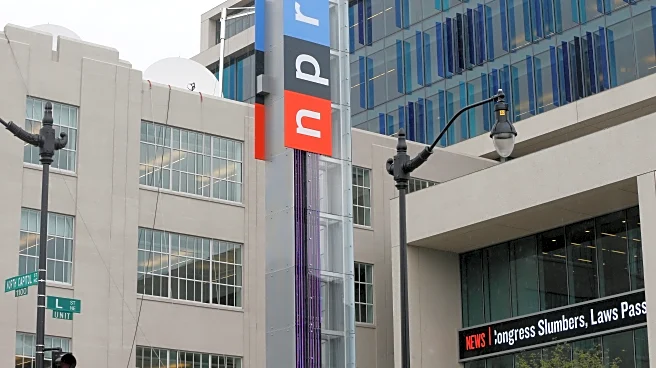
A federal judge has ruled that President Trump's executive order to defund NPR and PBS violates the First Amendment. The order, titled 'Ending Taxpayer Subsidies for Bias Media,' was issued in May of the previous year and aimed to cut federal funding
for these public broadcasters, accusing them of ideological bias. Judge Randolph D. Moss of the U.S. District Court for the District of Columbia declared the order 'unlawful and unenforceable,' stating it crossed the constitutional line by using government power to suppress disfavored expression. The ruling emphasized that the government cannot discriminate against news outlets based on their viewpoints. The decision could be appealed by the administration, but it currently allows for the possibility of future federal funding for public media.
Why It's Important?
This ruling is significant as it reaffirms the protection of free speech under the First Amendment, particularly for media organizations. The decision underscores the principle that the government cannot use its financial power to suppress media outlets based on their content. This has implications for the independence of public broadcasting in the U.S., ensuring that entities like NPR and PBS can continue to operate without political interference. The ruling also highlights the ongoing tension between the government and media organizations, particularly those perceived as critical of the administration. It sets a precedent for future cases involving government attempts to influence or control media content.
What's Next?
The administration may choose to appeal the decision, which could lead to further legal battles over the issue. Meanwhile, the ruling opens the door for Congress to potentially resume funding for public media, should it choose to do so. Public broadcasters like NPR and PBS will likely continue to advocate for their independence and the importance of unbiased reporting. The decision also empowers local public media stations to make independent programming decisions without fear of losing federal support. This case may influence future legislative and executive actions regarding media funding and regulation.