



What's Happening?
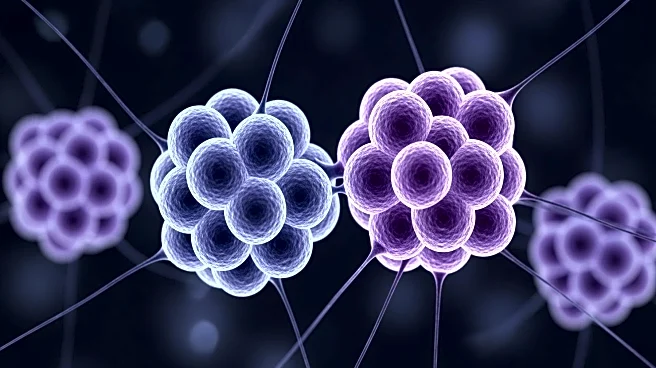
Recent research led by Nagoya University has uncovered a significant development in the understanding of ovarian cancer's rapid progression. The study, published in Science Advances, reveals that ovarian cancer cells form hybrid clusters with mesothelial
cells, which are typically protective linings in the abdominal cavity. These hybrid clusters are more resistant to chemotherapy and invade tissues more effectively than cancer cells alone. The research involved analyzing abdominal fluid from ovarian cancer patients and observing the interaction between cancer cells and mesothelial cells. The cancer cells release a signaling molecule, TGF-β1, which transforms mesothelial cells, enabling them to create pathways for cancer cells to follow. This discovery challenges previous assumptions that cancer cells drift freely and highlights the role of mesothelial cells in facilitating cancer spread.
Why It's Important?
This discovery is crucial as it opens new avenues for treating ovarian cancer, which is the deadliest gynecological cancer due to its late diagnosis and rapid spread. Current chemotherapy treatments target cancer cells but do not address the role of mesothelial cells in cancer progression. By understanding the interaction between cancer and mesothelial cells, new treatments could be developed to block the TGF-β1 signal or prevent the formation of these hybrid clusters, potentially improving patient outcomes. Additionally, monitoring these cell clusters in abdominal fluid could provide a new method for predicting disease progression and treatment response, offering a more proactive approach to managing ovarian cancer.
What's Next?
Future research and development could focus on creating drugs that specifically target the TGF-β1 signaling pathway or the formation of hybrid cell clusters. Clinical trials may be necessary to test the efficacy of such treatments. Additionally, the medical community might explore the use of abdominal fluid monitoring as a diagnostic tool to better predict and manage ovarian cancer progression. These steps could lead to more personalized and effective treatment plans for patients, potentially reducing the mortality rate associated with this aggressive cancer.
Beyond the Headlines
The study highlights the importance of understanding the microenvironment of cancer cells and their interactions with surrounding cells. This knowledge could lead to broader implications for other types of cancer that may use similar mechanisms to spread. Furthermore, the ethical considerations of developing new treatments that target not just cancer cells but also their accomplices could reshape the approach to cancer therapy, emphasizing the need for comprehensive strategies that address the complexity of cancer biology.