


What's Happening?
Previously undisclosed documents have emerged as part of an ongoing lawsuit filed by Massachusetts against ExxonMobil in 2019, providing new details on the company's internal deliberations regarding climate change from the 1980s to the 2010s. These documents,
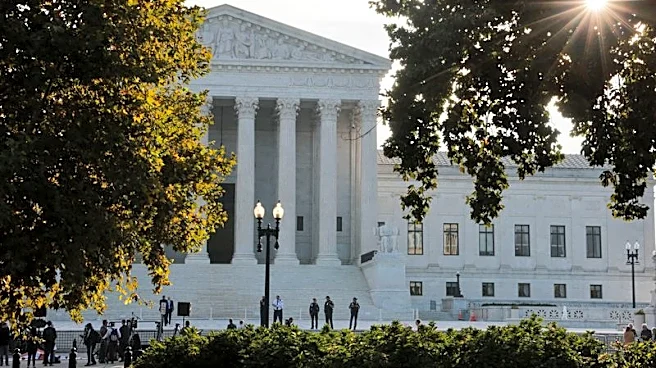
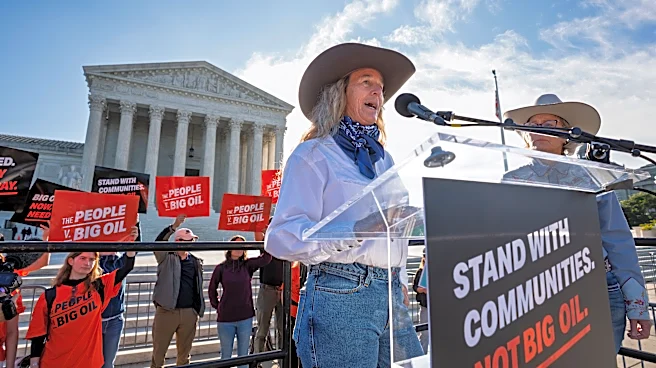
some reported for the first time, include a 1988 memo from Exxon's corporate research department warning of "substantial negative impacts on Exxon" if a worldwide consensus on climate action emerged. They also contain more recent statements from Exxon scientists challenging the company’s public claims about its work on biofuels and carbon capture and storage. For instance, an Exxon scientist testified that a 2018 press release touting the potential for 10,000 barrels of algae biofuel per day by 2025 was "patently false" and "completely impossible to achieve." Another scientist expressed skepticism about Exxon's claims of being a leader in carbon capture technology, noting that the company's operations were largely restricted to gas processing plants, not the broader applications promoted for power plants and industrial facilities. The release of these documents coincides with the U.S. Supreme Court hearing arguments from Exxon and Suncor Energy to halt a similar lawsuit filed by Boulder, Colorado, a decision that could impact over two dozen other claims against oil companies.
Why It's Important?
The release of these documents is highly significant for the ongoing legal battles against major oil companies regarding their alleged role in fueling climate change and deceiving the public. They provide further evidence that ExxonMobil was aware of the risks associated with fossil fuel emissions as early as 1988, while simultaneously engaging in public relations campaigns that experts now describe as deceptive. This new information could strengthen the legal arguments of states and municipalities seeking to hold oil companies accountable for the escalating costs of climate-fueled extreme weather. The internal scientific assessments contradicting public statements on biofuels and carbon capture technology suggest a deliberate strategy to manage public perception rather than genuinely pursue climate solutions. The outcome of the Supreme Court's decision on the Boulder lawsuit is critical, as it could determine whether numerous other climate deception cases against oil companies are allowed to proceed, potentially leading to significant financial liabilities and a re-evaluation of corporate responsibility in addressing climate change. This situation highlights the tension between corporate interests and public welfare in the context of environmental crises.
What's Next?
The immediate focus will be on the U.S. Supreme Court's decision regarding the lawsuit filed by Boulder, Colorado, against Exxon and Suncor Energy. This ruling will significantly influence the trajectory of over two dozen other similar claims against oil companies across the country. If the Supreme Court allows these lawsuits to proceed, it could open the door for extensive discovery processes, potentially unearthing even more internal documents and further exposing corporate strategies related to climate change. Conversely, a ruling in favor of Exxon and Suncor could severely impede efforts by states and municipalities to hold oil companies accountable through the court system. The Massachusetts lawsuit, which specifically targets deceptive practices towards consumers and investors, will continue to unfold, with the state seeking fines and an injunction against Exxon's alleged misleading actions. Advocacy groups like Public Citizen anticipate that more evidence of deception will emerge, intensifying public and legal pressure on the oil industry. ExxonMobil, which has denied misleading the public and views these lawsuits as an inappropriate use of the court system, will likely continue to vigorously defend itself against these allegations.
Beyond the Headlines
The deeper implications of the ExxonMobil climate deception case extend beyond legal and financial ramifications, touching upon fundamental questions of corporate ethics, public trust, and the role of scientific integrity in corporate decision-making. The documents reveal a sophisticated strategy to "weaponize experts" and influence public discourse, raising concerns about the manipulation of scientific information for commercial gain. This pattern of behavior, spanning decades, could erode public trust in corporate claims regarding environmental responsibility and sustainable initiatives. The case also highlights the long-term societal costs of delayed climate action, as communities now face escalating expenses from climate-fueled extreme weather events. Ethically, the revelations challenge the notion of corporate social responsibility, suggesting a prioritization of profit and business options over environmental stewardship and public health. Culturally, these disclosures contribute to a growing narrative of corporate accountability, potentially shifting public perception and increasing demand for transparency from large corporations. The legal battles could also trigger a re-evaluation of regulatory frameworks and oversight mechanisms to prevent similar instances of alleged deception in the future, fostering a more robust environment for climate action and corporate governance.