






What's Happening?
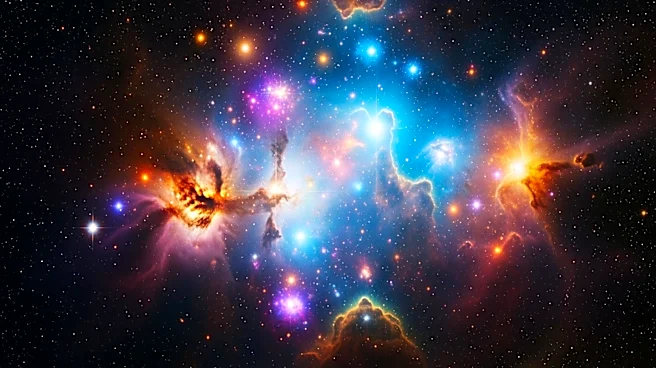
The James Webb Space Telescope (JWST) has captured a detailed image of the star-forming clouds in the Orion A molecular cloud, located approximately 1,300 light-years from Earth. This region, situated south of Orion's Belt, is one of the largest and closest
molecular clouds to our planet. The image, released as the JWST Picture of the Month, highlights the vibrant and colorful nature of Orion A, a stellar nursery that has produced around 3,000 stellar objects over the past few million years. The molecular cloud is home to young protostars surrounded by protoplanetary disks, which are expected to form planets. The study of such regions is crucial for understanding the formation of solar systems, including our own, which formed about 4.6 billion years ago.
Why It's Important?
The detailed imaging of Orion A by the JWST provides significant insights into the processes of star and planet formation. Understanding these processes is essential for comprehending the origins of solar systems, including our own. The ability to observe such regions in detail allows scientists to study the conditions and mechanisms that lead to the birth of stars and planets. This knowledge can inform models of cosmic evolution and the potential for life elsewhere in the universe. The JWST's capabilities in capturing such detailed images underscore its importance in advancing our understanding of the cosmos.