
What's Happening?
The James Webb Space Telescope (JWST) successfully launched on December 25, 2021, from Europe's Spaceport in French Guiana. This marked the end of a prolonged development period characterized by numerous
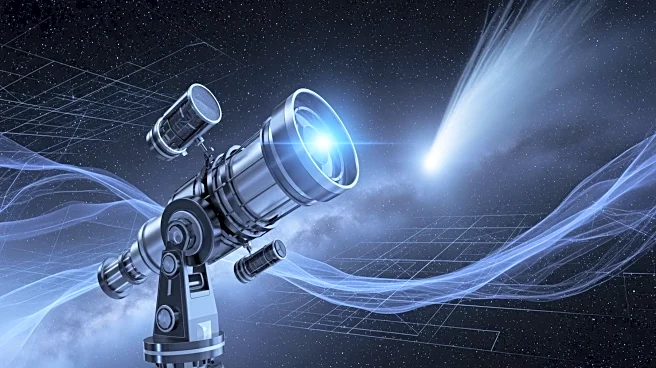
delays and budget overruns. Originally planned for a 2007 launch with a budget of $500 million, the project ultimately cost $10 billion and took 14 years to complete. JWST is a collaborative effort between NASA, the European Space Agency (ESA), and the Canadian Space Agency (CSA). The telescope features a 6.5-meter segmented mirror and a five-layer sunshield, designed to maintain extremely low temperatures necessary for infrared observations. Its mission is to detect redshifted light from early galaxies and observe young stars within dusty nebulae, tasks that require minimizing interference through extreme cooling.
Why It's Important?
The successful launch of the JWST is a significant milestone in space exploration and astronomy. As the most powerful space telescope ever built, it promises to expand our understanding of the universe by observing phenomena that were previously beyond our reach. The telescope's ability to study the early universe and star formation processes could lead to groundbreaking discoveries about the origins of galaxies and the conditions that foster star and planet formation. This mission is crucial for the scientific community, as it builds on the legacy of the Hubble Space Telescope and aims to answer fundamental questions about the cosmos. The collaboration between NASA, ESA, and CSA also highlights the importance of international cooperation in advancing scientific knowledge.
What's Next?
Following its launch, the JWST will undergo a month-long journey to reach its operational orbit approximately 1.5 million kilometers from Earth. Once in position, the telescope will begin its scientific operations, which are expected to last for at least a decade. The scientific community eagerly anticipates the data that JWST will provide, which could lead to new insights into the formation and evolution of galaxies, stars, and planetary systems. The telescope's findings may also influence future space missions and research priorities, as scientists analyze the data to refine existing theories and develop new ones.
Beyond the Headlines
The JWST's mission extends beyond scientific discovery; it also represents a triumph over technical and financial challenges. The project's completion, despite its setbacks, demonstrates the resilience and determination of the scientific community to push the boundaries of human knowledge. The telescope's advanced technology and design innovations may inspire future space exploration projects, setting new standards for what is possible in the field. Additionally, the international collaboration involved in the JWST project underscores the global nature of scientific inquiry and the shared human quest to understand the universe.