




What's Happening?
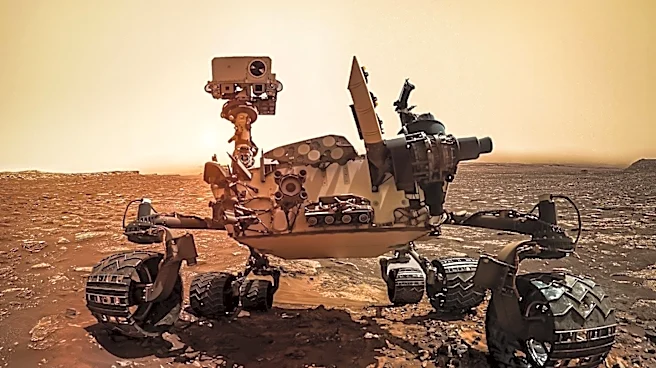
NASA's Curiosity Mars rover has sustained extensive wheel damage after nearly 14 years on Mars, as revealed by recent images. The rover's aluminum wheels, designed with special treads for traction, have developed deep cracks and dents due to the harsh
Martian terrain. Despite the damage, Curiosity has made significant discoveries, including evidence of ancient water and conditions suitable for microbial life in Gale Crater. NASA engineers have been aware of the wheel deterioration and have adjusted the rover's driving strategies to mitigate further damage. The rover's radioisotope power system has allowed it to continue operations beyond its expected lifespan, unlike solar-powered rovers.
Why It's Important?
The damage to Curiosity's wheels highlights the engineering challenges of operating machinery on Mars, where repair is not possible. The rover's continued functionality is crucial for ongoing scientific research, as it provides valuable data on Mars' past environments and potential for life. The findings from Curiosity have reshaped our understanding of Mars, offering insights into its transformation from a wetter world to the arid planet we see today. The rover's success underscores the importance of robust engineering and adaptive strategies in space exploration, informing future missions to Mars and beyond.
What's Next?
NASA will continue to monitor Curiosity's mechanical systems and wheel health to ensure its ongoing operation. The rover's mission will persist as long as it remains functional, contributing to our understanding of Mars. Future missions may incorporate lessons learned from Curiosity's wheel damage, leading to improved designs for durability. The data collected by Curiosity will support upcoming missions, such as the Mars Sample Return program, which aims to bring Martian samples back to Earth for detailed analysis.