









What's Happening?
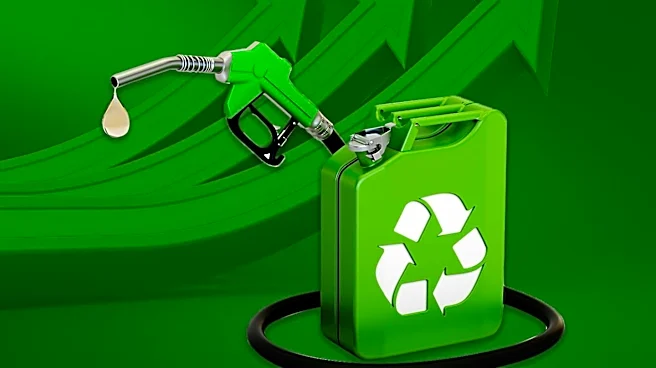
Chinese researchers from the Shanghai Advanced Research Institute of the Chinese Academy of Sciences and Fudan University have developed a new chemical technique to convert plastic waste into aviation fuel. This method focuses on the hydrogenolysis of polyolefins,
which are primarily polythene and polypropylene, accounting for over 60% of plastic waste. The process operates under mild conditions and allows for tunable product selectivity, making it a potentially low-cost and environmentally friendly alternative to traditional disposal methods like incineration and landfilling. The technique uses metal catalysts to selectively cleave and rearrange carbon-carbon bonds, producing hydrocarbons suitable for aviation fuel.
Why It's Important?
This development is significant as it offers a promising solution to the global plastic waste problem, which sees over 460 million tonnes of plastic produced annually. Traditional disposal methods are not only wasteful but also contribute significantly to pollution. By converting plastic waste into jet fuel, this method could reduce environmental impact and provide a sustainable alternative to fossil fuels in the aviation industry. The ability to produce aviation fuel from waste materials could also lead to economic benefits, reducing reliance on traditional fuel sources and potentially lowering costs for the aviation sector.
What's Next?
The next steps for this technology could involve scaling up the process for industrial use and assessing its economic viability on a larger scale. If successful, it could lead to widespread adoption in the aviation industry and beyond, potentially influencing global waste management practices. Further research may focus on optimizing the process and exploring its application to other types of plastic waste. Stakeholders in the aviation and waste management industries, as well as environmental policymakers, will likely monitor developments closely.
Beyond the Headlines
This innovation could have broader implications for global environmental policies and the circular economy. By transforming waste into a valuable resource, it challenges traditional views on waste management and resource utilization. The method also highlights the potential of scientific research to address complex environmental issues, encouraging further investment in sustainable technologies. Additionally, it may prompt discussions on international cooperation in technology sharing and environmental protection.