



What's Happening?
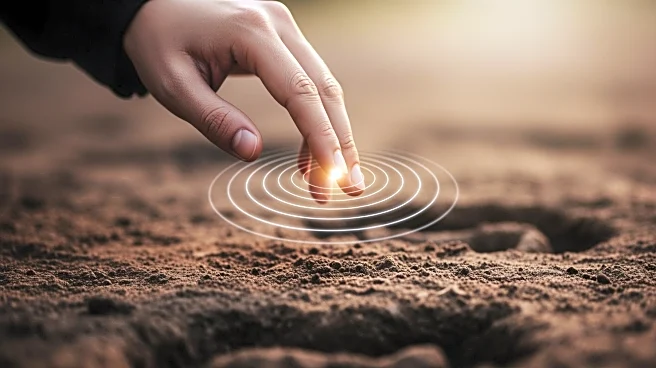
Researchers have identified a previously unknown human sensory ability termed 'remote touch,' which allows individuals to detect objects buried in loose materials like sand without direct contact. In experiments, participants were able to identify hidden
cubes with approximately 70% accuracy by sensing subtle pressure changes in the sand. This discovery suggests that humans can perceive faint pressure ripples, similar to certain bird species that detect prey beneath wet sand. The study, led by Elisabetta Versace from Queen Mary University of London, highlights that human judgment in detecting these subtle signals surpasses that of robotic systems trained for the same task.
Why It's Important?
The discovery of remote touch in humans could have significant implications for various fields such as archaeology, forensics, and planetary science, where traditional visual methods may be limited. This ability to perceive weak mechanical cues could enhance precision and safety in fieldwork, reducing accidental damage during excavations. Additionally, understanding and harnessing this sensory capability could lead to advancements in technology, particularly in developing more sensitive and accurate robotic systems for detecting buried objects. The research also provides insights into the evolutionary aspects of human sensory perception, suggesting that this ability might be a dormant capability rather than a newly evolved one.
What's Next?
Future research is expected to explore the application of remote touch in different granular media beyond sand, such as soil or plastic beads, to understand how factors like grain size and friction affect detection. Further studies may also investigate the impact of variables such as finger speed and object shape on the sensory field. Additionally, improving robotic training through a combination of physics-based simulations and real-world trials could enhance the accuracy of machines in detecting buried objects, potentially closing the gap between human and robotic sensory capabilities.
Beyond the Headlines
The concept of remote touch challenges traditional views of human sensory perception, suggesting that our nervous system can interpret faint physical cues without direct contact. This finding opens up new avenues for exploring how deeply tactile processing is embedded in humans and how it can be applied in practical scenarios. The research also draws parallels with sensory mechanisms in other species, such as fish and mammals, indicating a broader evolutionary context for this ability.