




What's Happening?
The Nature Conservancy (TNC) and the USDA Forest Service have announced a $2.1 million commitment to expand forest restoration activities across national forests in Idaho and Wyoming. This funding will support efforts to improve forest health and enhance
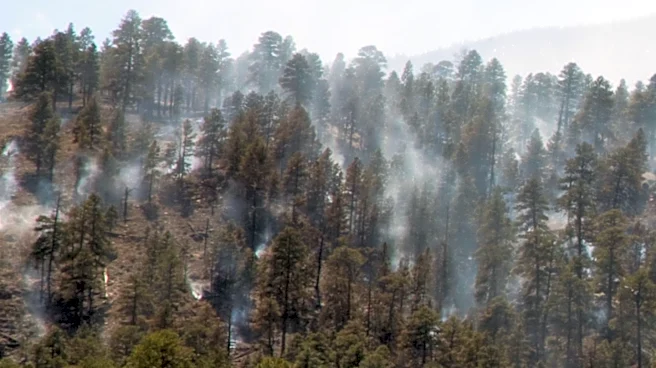
community safety by reducing hazardous overgrowth that contributes to extreme wildfires. TNC will provide additional workforce capacity to assist with prescribed fire initiatives, ecological thinning, and other restoration tasks. The projects will concentrate on national forests located within the wildland-urban interface (WUI), areas where existing partnerships between the Forest Service and TNC are already established. These include the Caribou-Targhee, Payette, and Salmon-Challis National Forests in Idaho, and the Bridger-Teton National Forest in Wyoming.
Why It's Important?
This joint initiative is crucial for addressing the escalating threat of wildfires in the Western United States and promoting long-term forest resilience. By focusing on ecological thinning and prescribed burns, the project aims to reduce fuel loads, which are a primary driver of large, destructive wildfires. This proactive approach not only protects natural ecosystems but also safeguards communities situated near forested areas, reducing risks to lives and property. The collaboration between a non-profit organization like TNC and a federal agency like the Forest Service demonstrates a model for effective public-private partnerships in conservation. The investment signifies a commitment to science-based forest management strategies that are essential for adapting to changing climate conditions and maintaining healthy forest landscapes.
What's Next?
Under mutual interest agreements, TNC fire crews will begin supporting various aspects of prescribed fire preparation, including thinning crowded trees, clearing overgrown brush, burning slash piles, and conducting broadcast burning. These crews will also be involved in data collection and monitoring to assess the effectiveness of prescribed fire treatments. Additionally, some crews will engage with local communities through workshops designed to help homeowners in WUI areas implement measures to reduce their wildfire risk. This integrated approach suggests ongoing efforts to not only restore forests but also to build community resilience against wildfires. The success of these projects could serve as a model for similar initiatives in other fire-prone regions across the U.S.
Beyond the Headlines
This collaboration extends beyond immediate wildfire mitigation, touching upon broader themes of ecological restoration and community adaptation to environmental change. The emphasis on ecological thinning and prescribed fire reflects a shift in forest management philosophy from fire suppression to fire adaptation, recognizing fire as a natural and necessary component of many forest ecosystems. By actively managing forests to mimic natural processes, the project aims to create more resilient landscapes that can withstand future disturbances. Furthermore, the engagement with local communities highlights the critical role of public education and participation in wildfire preparedness, fostering a shared responsibility for land stewardship. This initiative represents a long-term investment in the health of national forests and the safety of adjacent communities, addressing complex environmental challenges through collaborative action.