



What's Happening?
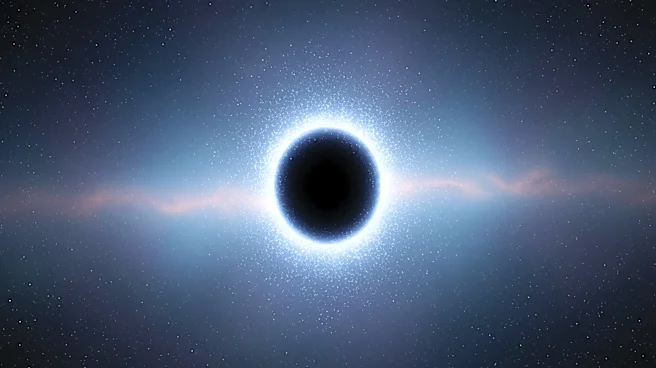
Recent research suggests that primordial black holes, formed shortly after the Big Bang, may have played a crucial role in shaping the early universe. These black holes, which are different from the stellar-mass black holes observed today, are believed
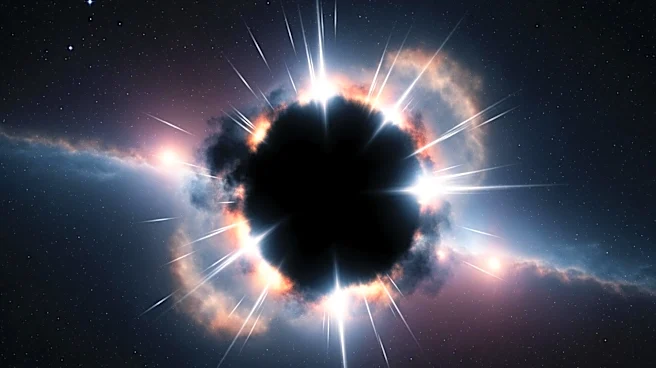
to have exploded violently, creating shock waves that contributed to the formation of matter as we know it. The study, conducted by researchers from Vrije Universiteit Brussel and MIT, proposes that these explosions could explain baryogenesis, the process by which matter came to dominate over antimatter in the universe. The findings are based on the hydrodynamics of plasma around dying primordial black holes, which released immense energy, creating pressure gradients and shock waves in the early universe's quark-gluon soup.
Why It's Important?
This theory provides a potential explanation for the matter-antimatter imbalance observed in the universe, a fundamental question in cosmology. Understanding the role of primordial black holes in the early universe could offer insights into the conditions that led to the formation of galaxies and other cosmic structures. The research also highlights the importance of studying extreme conditions in the early universe to uncover the origins of matter. If validated, this theory could reshape our understanding of the universe's evolution and the fundamental processes that led to the creation of matter.