



What's Happening?
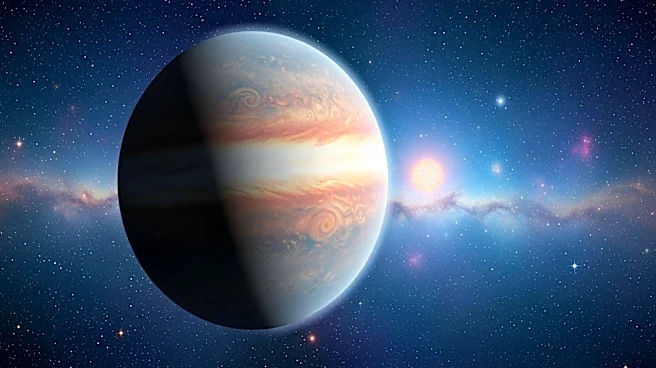
Astronomers have discovered a massive exoplanet, TOI-5205 b, orbiting a small red dwarf star, which contradicts established theories of planetary formation. This Jupiter-sized planet orbits a star that is significantly smaller and less massive than the Sun,
a scenario previously thought impossible. The planet's transit behavior, blocking nearly 6% of its host star's light, allowed researchers to study its atmosphere in detail using the James Webb Space Telescope. The atmosphere contains methane and hydrogen sulfide but is notably deficient in heavier elements, a finding that challenges existing models of planet formation. This discovery suggests that the processes involved in the formation of TOI-5205 b were fundamentally different, prompting scientists to reconsider how such systems evolve.
Why It's Important?
The discovery of TOI-5205 b is significant as it challenges long-standing theories about how planets form, particularly around small stars. The planet's unusual atmospheric composition, lacking heavier elements, suggests a different formation process that could have broader implications for understanding planetary systems. This finding may lead to a reevaluation of the assumptions about the mixing of materials within giant planets and their atmospheres. The research highlights the complexity of planetary formation and the need for new models to explain such anomalies. As more data is gathered, TOI-5205 b could represent a broader class of unexpected worlds, potentially refining or overturning existing theories.
What's Next?
Further studies are expected to explore the internal composition of TOI-5205 b, which may hold a large reservoir of heavy elements despite its atmospheric deficiency. Researchers will continue to use advanced models to understand the planet's formation and structure. The discovery also opens new avenues for studying planets around active stars, as the host star's activity can distort observational data. The ongoing James Webb Space Telescope programs will test methods to correct for such activity, enhancing the study of planets orbiting M-dwarf stars. This research is part of the GEMS Survey, focusing on giant planets around these common stars, which is crucial for a complete picture of planet formation.
Beyond the Headlines
The discovery of TOI-5205 b highlights the potential for hidden internal compositions in giant planets that are not reflected in their atmospheres. This could complicate efforts to infer planetary makeup solely from atmospheric observations. The planet's chemical profile suggests a carbon-rich, oxygen-poor environment, influencing cloud formation and thermal structure. The host star's starspots add complexity to the study, requiring new methods to ensure accurate atmospheric signals. This research marks a step forward in understanding planets around active stars and may lead to the identification of more unexpected worlds.