
What's Happening?
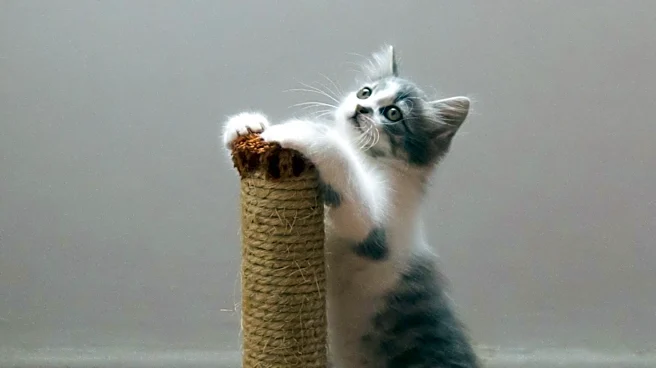
New research has revealed that cats use unique chemical signatures in their urine, specifically branched-chain fatty acids (BFAs), to identify one another. Published on August 19 in the journal Current
Biology, the study found that these BFAs create a stable 'chemical fingerprint' for each cat. Researchers observed that cats exhibit a 'flehmen response'—an open-mouthed expression used to draw chemicals into their vomeronasal organ—less frequently when encountering familiar urine samples, but more often with new ones. By analyzing urine components, scientists isolated BFAs as the key compounds triggering this response. Each cat possesses a distinct mix of BFAs, which remain stable for at least a day, suggesting their role in long-lasting scent marks. The study also identified unusual fat droplets in cat kidneys, specifically in the renal cortex, which are believed to act as reservoirs maintaining these individual BCFA profiles despite dietary or health changes. This discovery sheds light on a long-standing mystery regarding the purpose of these kidney droplets, known to exist for over a century.
Why It's Important?
This discovery significantly advances the understanding of feline communication and mammalian scent marking. By decoding the chemical 'messages' in cat urine, scientists gain deeper insights into how animals recognize individuals within their species, a process crucial for social interactions, territorial marking, and reproductive behaviors. The stability of these chemical fingerprints, maintained by kidney lipid droplets, highlights a sophisticated biological mechanism for individual identification that persists over time. This research could have broader implications for veterinary science, particularly in understanding feline health. For instance, future studies could explore whether disruptions in the formation or maintenance of these lipid droplets and BFAs contribute to chronic kidney disease in cats, a common ailment. Furthermore, the finding that large cats like lions and tigers also possess BFAs and similar kidney structures suggests an evolutionary conservation of this identification system, opening avenues for comparative studies across the feline family and potentially other mammals.
What's Next?
The research team plans to further investigate the mechanisms behind the formation, maintenance, mobilization, and secretion of these lipid droplets and branched-chain fatty acids into urine. A key area of future inquiry will be to determine if disruptions in these processes are linked to chronic kidney disease in cats, which could lead to new diagnostic tools or therapeutic approaches for this condition. Additionally, researchers are interested in exploring the evolutionary diversification of these features across different cat species, given that specific BFAs and droplet numbers varied among large cats like lions and tigers. This comparative analysis could reveal how these chemical signaling systems have adapted over time. The findings may also inspire studies into similar chemical identification systems in other mammalian species, potentially uncovering universal principles of scent-based communication and individual recognition in the animal kingdom.
Beyond the Headlines
The revelation of unique chemical fingerprints in cat urine extends beyond mere animal behavior, touching upon fundamental biological principles of individuality and communication. The stability of these chemical signatures, maintained by specialized kidney structures, underscores the complexity and efficiency of natural biological systems in encoding and transmitting information. This research highlights how seemingly simple bodily excretions can carry intricate data essential for species survival and social cohesion. Ethically, understanding these natural communication methods could inform more humane approaches to animal management, such as reducing stress in multi-cat households or improving conservation efforts for wild felines by better understanding their territorial and social dynamics. Legally, while not directly applicable, the concept of a stable, individual chemical signature could, in a very abstract sense, draw parallels to forensic science, where unique biological markers are crucial for identification. Culturally, this study deepens our appreciation for the hidden world of animal senses, reminding us that much of animal interaction occurs through channels imperceptible to humans, fostering a greater respect for the intricate lives of our companion animals and wildlife.