







What's Happening?
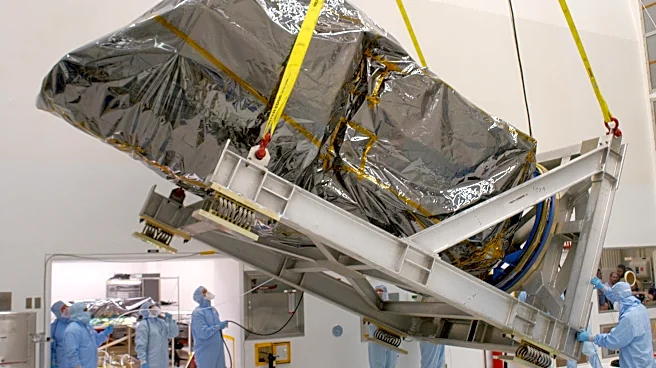
The U.S. Space Force predicts that NASA's Swift Observatory, an aging telescope, is on the verge of re-entering Earth's atmosphere on or around Friday, following a failed rescue mission. The 1 1/2-ton telescope is expected to largely burn up during reentry,
though some pieces made of dense tungsten and mirror parts could survive, according to NASA's Brad Cenko, the mission’s chief scientist. While any surviving wreckage is most likely to fall into the ocean, parts of Africa, Australia, India, Southeast Asia, and Central and South America are within the potential reentry zone. The Space Force is actively tracking the telescope's trajectory. Intense solar activity over recent years accelerated Swift's descent. NASA had contracted Katalyst Space a year ago for a rescue attempt, but their robot, Link, encountered issues after its July launch and failed to reach the telescope, subsequently plunging back to Earth in September.
Why It's Important?
The impending reentry of the Swift Observatory marks the end of a significant scientific mission that has contributed immensely to astrophysics. Swift was crucial for detecting gamma-ray bursts and supernovas, acting as a 'first responder' for other major telescopes like Hubble and Webb, alerting them to celestial events for deeper investigation. Its loss creates a gap in the scientific community's ability to rapidly detect and study these high-energy phenomena. The failed rescue mission also highlights the complexities and challenges of in-orbit servicing and debris mitigation. The potential for surviving fragments, though likely to land in the ocean, underscores the broader issue of uncontrolled reentries of space objects and the need for robust international protocols for space traffic management and end-of-life planning for satellites.
What's Next?
The U.S. Space Force will continue to track the Swift Observatory's dwindling path until its predicted reentry on or around Friday. Scientists are now focused on understanding how to fill the observational gap left by Swift's retirement. The lessons learned from Swift's 22 years of operation, particularly its ability to swiftly swivel and detect cosmic events, will be crucial for designing future generations of space missions. The incident also serves as a reminder for space agencies and private companies to prioritize deorbiting strategies and in-orbit servicing capabilities for future spacecraft to prevent uncontrolled reentries and manage space debris effectively.
Beyond the Headlines
The Swift Observatory's demise, despite a rescue attempt, brings to light the growing challenge of managing an increasing number of aging satellites and space debris. As more objects are launched into orbit, the risk of uncontrolled reentries and potential ground impact, however small, becomes a more pressing concern. This event could spur further discussions and investments in technologies for active debris removal and satellite servicing, which are vital for the long-term sustainability of space operations. Furthermore, the scientific community will need to adapt its research strategies to compensate for the loss of Swift's unique capabilities, potentially accelerating the development of new instruments or re-prioritizing observations with existing telescopes.