

What's Happening?
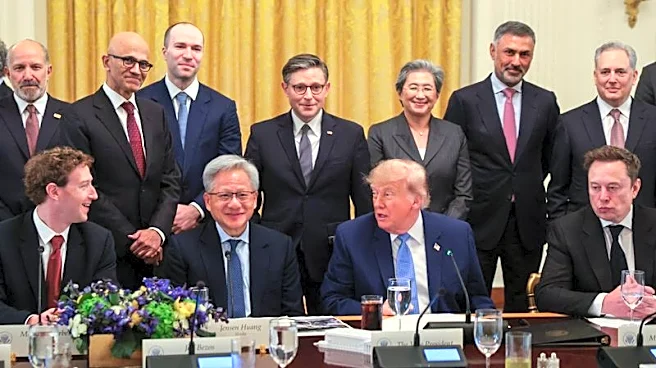
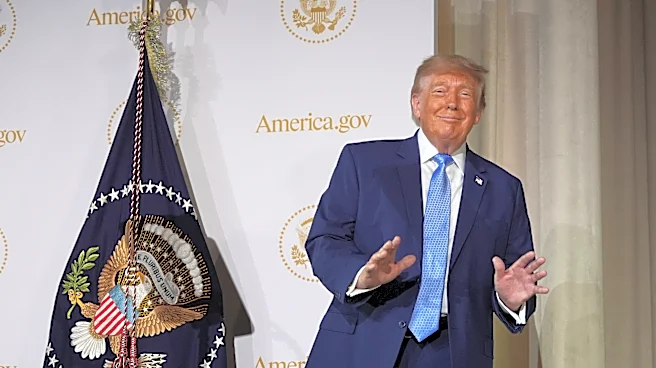
President Trump has announced his intention to appoint a White House 'AI czar' within days, as part of a broader 'AI Force' initiative aimed at accelerating U.S. artificial intelligence development. This announcement, made on Truth Social on September
19, likens the initiative to the Space Force, though details regarding its civilian or military nature, governmental placement, and specific powers remain unspecified. The proposed 'AI Force' builds upon the administration's July 2025 America's AI Action Plan, which outlines over 90 federal actions across three pillars: innovation, infrastructure, and diplomacy and security. Key aspects of this plan include reducing regulatory barriers, expediting permitting for data centers and semiconductor fabrication facilities, and exporting U.S. 'full-stack' AI packages to allies. The position of AI czar has been effectively vacant since David Sacks exhausted his special-government-employee limit in March 2026. While Treasury Secretary Scott Bessent was reportedly considered, President Trump explicitly ruled him out on September 25. The White House has not yet confirmed the identity or exact timing of the appointee.
Why It's Important?
The appointment of an AI czar and the development of the 'AI Force' plan signal a significant federal commitment to fostering rapid AI growth and maintaining U.S. competitiveness, particularly against China. This pro-growth stance is expected to benefit AI model developers, cloud providers, chipmakers, and data center operators by reducing policy uncertainty and prioritizing infrastructure development. Faster permitting for data centers could also drive demand for various energy and construction sectors, including generation capacity, transmission, natural gas, nuclear development, renewables, transformers, and HVAC systems. The White House plan specifically identifies the capacity of electricians and HVAC workers as a potential constraint, highlighting the broader economic impact. However, this accelerationist approach has drawn criticism from researchers, lawmakers, and AI company leaders who warn about potential cyber, biosecurity, fraud, misinformation, and labor-market risks that may not be adequately addressed by existing legal frameworks. The debate centers on whether the U.S. should prioritize speed in AI development or establish stronger safeguards first.
What's Next?
The immediate next step is the announcement of the AI czar's identity, which President Trump indicated would occur within days. The nature of this nominee—whether a technology executive, venture capitalist, national security figure, or policy specialist—will signal the administration's primary focus for AI development. Following the appointment, a key question is whether the White House will release a formal memorandum defining the 'AI Force's' membership, reporting structure, funding, and deliverables. Without such a document, the initiative may serve more as a policy signal than a durable new institution. Industry stakeholders will likely welcome a senior coordinator who can streamline federal engagement and signal support for investment, provided the role does not become a new regulatory bottleneck. Conversely, safety advocates and civil rights groups are expected to scrutinize the reliance on existing laws, particularly concerning issues like systemic bias, opaque decision-making, election misinformation, and AI-enabled cyber abuse. The long-term effects could involve the pace and location of U.S. data center and energy infrastructure construction, the balance between federal preemption and state AI laws, and U.S. alliances and export strategies for chips, cloud services, models, and technical standards.
Beyond the Headlines
Beyond the immediate policy implications, the 'AI Force' initiative and the appointment of an AI czar underscore a deeper philosophical divide within the U.S. regarding AI governance. President Trump's accelerationist stance, prioritizing rapid private-sector growth and competition with China, contrasts with calls for stronger safeguards and new regulations to mitigate potential societal risks. This divergence highlights the tension between fostering innovation and ensuring responsible development. The administration's emphasis on using existing laws rather than sweeping new AI-specific restrictions suggests a preference for a less interventionist regulatory environment, which could have long-term implications for the ethical development and deployment of AI technologies. The debate also touches upon the very definition of AI, with the White House's July 2025 plan and subsequent executive orders moving towards the term 'Super Intelligence' to convey the advanced capabilities and transformative potential of these technologies. This linguistic shift reflects a broader effort to frame AI as a tool for unprecedented human creativity and achievement, rather than merely automation, potentially influencing public perception and future policy directions.