



What's Happening?
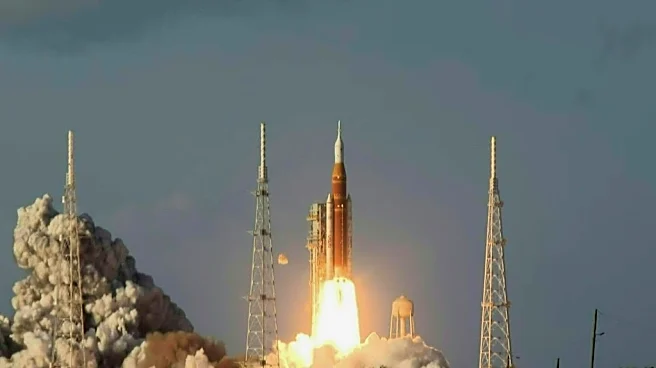
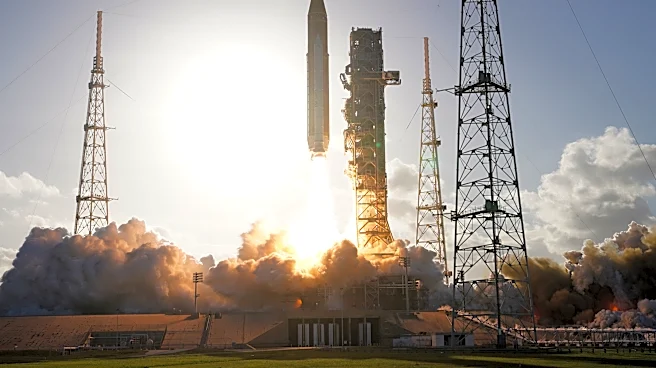
NASA's Artemis II mission, which launched on April 1, 2026, from Kennedy Space Center in Florida, is currently underway with four astronauts aboard the Orion spacecraft. As of April 3, the spacecraft was over 72,000 miles from Earth, traveling at a speed
of 4,880 mph, with approximately 180,000 miles remaining before reaching the moon. The mission is part of NASA's efforts to send astronauts to orbit the moon and return safely. NASA has provided a real-time tracking system, known as the Artemis Real-time Orbit Website (AROW), which allows the public to follow the spacecraft's journey. This tracker is available both as a desktop website and a mobile app, offering features such as augmented reality to visualize the spacecraft's position relative to Earth. The mission is expected to last 10 days, during which astronauts will conduct various exercises and safety demonstrations.
Why It's Important?
The Artemis II mission is a significant step in NASA's broader Artemis program, which aims to establish a sustainable human presence on the moon by the end of the decade. This mission serves as a precursor to future lunar landings and is crucial for testing systems and procedures that will be used in subsequent missions. The real-time tracking system enhances public engagement and transparency, allowing people to follow the mission's progress closely. Successful completion of Artemis II will pave the way for Artemis III, which aims to land astronauts on the lunar surface. The mission also contributes to international collaboration in space exploration, as NASA partners with other space agencies and private companies to achieve its goals.
What's Next?
Following the completion of the Artemis II mission, NASA will analyze the data collected to refine systems and procedures for future missions. The next major milestone will be the Artemis III mission, which is planned to land astronauts on the moon. NASA will continue to develop technologies and infrastructure necessary for long-term lunar exploration, including habitats and transportation systems. The success of Artemis II will also influence funding and policy decisions related to space exploration, as stakeholders assess the program's progress and potential. Public interest and support for space exploration are likely to increase as the Artemis program advances.