








What's Happening?
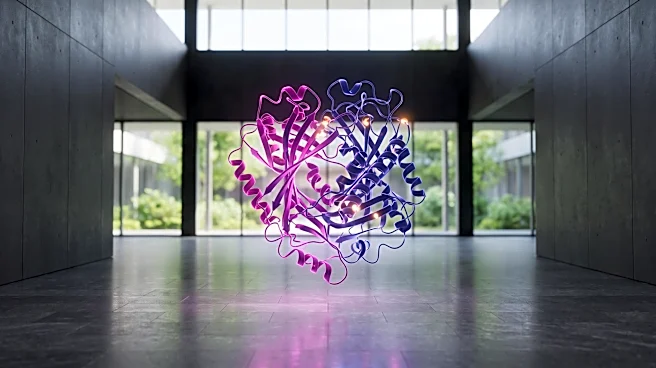
Researchers have utilized artificial intelligence to design new proteins capable of breaking down highly stable peptide bonds. Peptide bonds, which link amino acids to form proteins, typically have a half-life of several hundred years in water, making
them exceptionally stable. Organisms naturally produce various protein-digesting enzymes, known as proteases, to break these bonds. The new AI-designed enzymes mimic the catalytic core of two types of proteases, a zinc protease and another mechanism, to efficiently cleave specific proteins. This breakthrough allows for the targeted breakdown of proteins, including those implicated in neurological diseases. The AI-driven approach effectively short-circuits the natural diversification process of enzymes, enabling the creation of tailored protein-cutting tools. This development represents a significant advancement in protein engineering and could have broad implications for various scientific and medical fields.
Why It's Important?
This advancement holds significant importance for medical research, particularly in the context of neurological diseases. By designing proteins that can specifically cut other proteins, researchers gain a powerful tool to investigate and potentially target disease-causing protein aggregates. Many neurological conditions, such as Alzheimer's and Parkinson's, are characterized by the accumulation of misfolded or aggregated proteins. The ability to precisely break down these problematic proteins could lead to novel therapeutic strategies. Furthermore, this AI-driven approach to protein design could accelerate drug discovery and development by enabling the creation of highly specific enzymes for various biochemical applications. It demonstrates the growing power of artificial intelligence in revolutionizing biotechnology and medicine, offering new avenues for understanding and treating complex diseases.
What's Next?
The immediate next steps involve further testing and refinement of these AI-designed proteins. Researchers will likely focus on optimizing their specificity and efficiency in breaking down a wider range of target proteins, especially those relevant to various diseases. The potential application in neurological disease research suggests that future studies will explore the efficacy of these enzymes in cellular and animal models of such conditions. This could pave the way for the development of new diagnostic tools or therapeutic agents. Additionally, the methodology itself, using AI to design novel proteins, is likely to be applied to other areas of biotechnology, potentially leading to the creation of enzymes for industrial processes, bioremediation, or the synthesis of new materials. Collaboration between AI specialists and biochemists will be crucial for translating these laboratory findings into practical applications.
Beyond the Headlines
The development of AI-designed proteins that can precisely cleave highly stable peptide bonds has profound implications beyond immediate medical applications. Ethically, the ability to engineer proteins with such specificity raises questions about the potential for misuse, though the current focus is on therapeutic and research benefits. Scientifically, this breakthrough challenges traditional understandings of protein evolution and design, demonstrating that complex biological functions can be engineered rather than solely relying on natural selection. It highlights a paradigm shift in biotechnology, where AI is not just assisting but actively creating novel biological entities. This could lead to a deeper understanding of protein structure-function relationships and the fundamental principles governing biological catalysis. The long-term impact could include the development of entirely new classes of biomaterials, advanced diagnostics, and highly targeted therapies that were previously unimaginable, fundamentally altering how we approach biological problems and solutions.