










What's Happening?
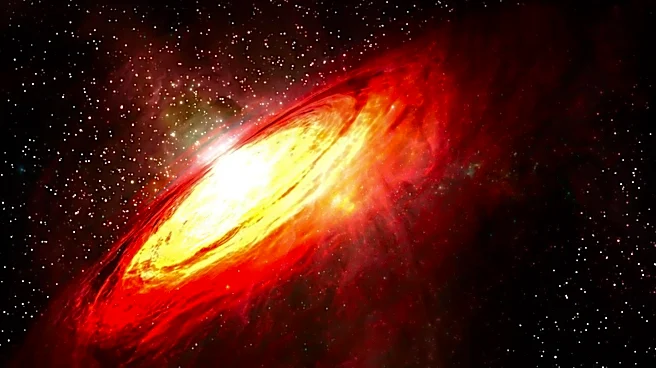
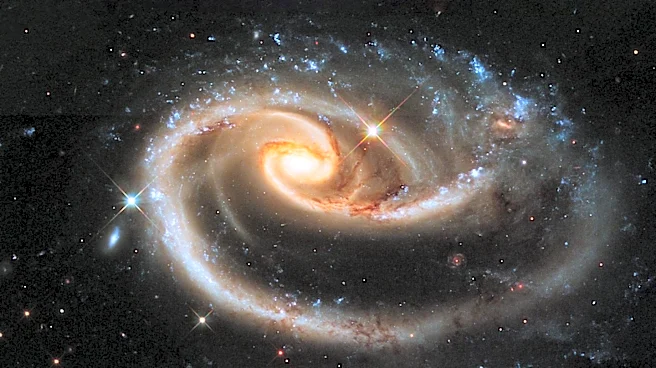
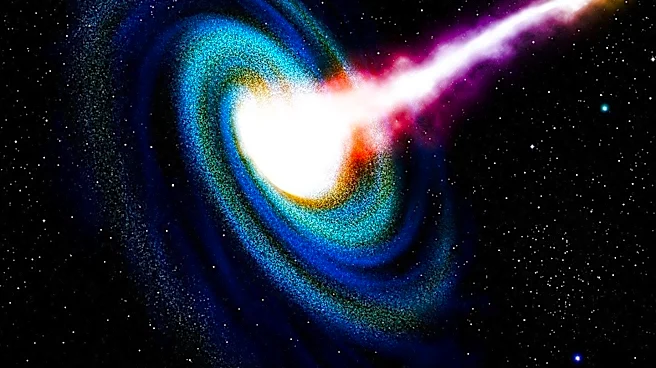
Recent research has revealed that the Milky Way galaxy may be larger, heavier, and more asymmetrical than previously estimated. Scientists have discovered that two of the galaxy's spiral arms, the Outer and Scutum-Centaurus arms, are further away from
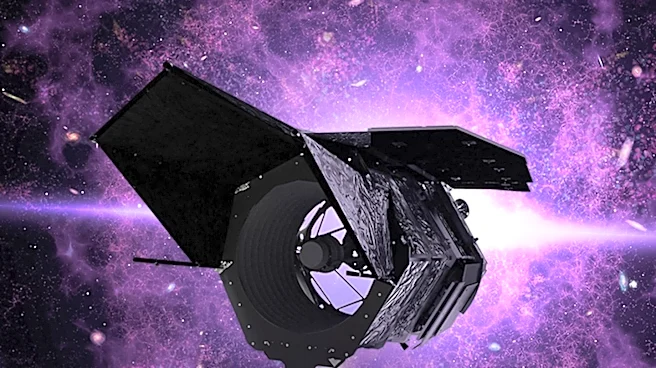
Earth than previously thought. This discovery was made by analyzing the echoes of gamma-ray bursts (GRBs) as they passed through dense gas clouds in these arms. The study, led by Beatrice Vaia from the Italian National Institute for Astrophysics, utilized data from NASA's Chandra X-ray Observatory and the European Space Agency's XMM-Newton observatory. The findings suggest that the Milky Way's mass and shape may need to be reconsidered, as the galaxy could be wider and more massive than earlier believed.
Why It's Important?
The implications of this discovery are significant for our understanding of the Milky Way and its place in the universe. A larger and more massive galaxy could affect estimates of the galaxy's gravitational influence and its interactions with neighboring galaxies. This could also impact our understanding of the distribution of dark matter within the Milky Way. The asymmetry in the galaxy's structure challenges previous models that assumed a more symmetrical spiral shape, prompting a reevaluation of galactic formation theories. These findings could lead to new insights into the dynamics and evolution of spiral galaxies, influencing future astronomical research and exploration.
What's Next?
Researchers are now seeking additional gamma-ray bursts to further map the Milky Way's structure and refine their understanding of its shape and mass. However, finding suitable GRBs is challenging, as they are rare cosmic events. The team will continue to monitor the universe for these occurrences, hoping to gather more data to complete the picture of our galaxy. This ongoing research could lead to further revisions of the Milky Way's characteristics and enhance our comprehension of the universe's structure.
Beyond the Headlines
The discovery of the Milky Way's asymmetry raises questions about the processes that led to its current form. Understanding the factors contributing to this lopsidedness could provide insights into the history of galactic collisions and mergers. Additionally, the study highlights the importance of innovative methods in astronomy, such as using GRB echoes, to overcome the limitations of traditional observational techniques. This approach could be applied to other galaxies, offering a new perspective on the universe's vast and complex structures.