

What's Happening?
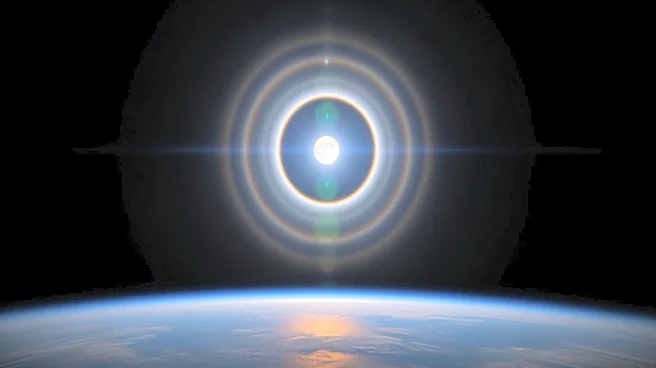
An astronaut aboard the International Space Station (ISS) recently captured a rare lunar halo, an optical phenomenon visible from space. This image, taken above the Indian Ocean, shows a delicate arc of light around the Moon, caused by moonlight refracting
through ice crystals in Earth's atmosphere. The ISS's high orbit allows for clear views of such phenomena, free from weather distortions. This type of photography, led by NASA's Crew Earth Observations facility, aids in studying Earth's atmosphere by capturing fleeting moments of natural beauty and scientific interest.
Why It's Important?
The capture of a lunar halo from space provides valuable insights into atmospheric optics and the behavior of ice crystals in Earth's upper atmosphere. Such observations help scientists understand how light, weather, and chemistry interact on a planetary scale. This knowledge is crucial for advancing atmospheric science and can inform climate models and weather prediction. The ability to observe these phenomena from space offers a unique perspective that is not possible from the ground, enhancing our understanding of Earth's atmospheric processes.