
What's Happening?
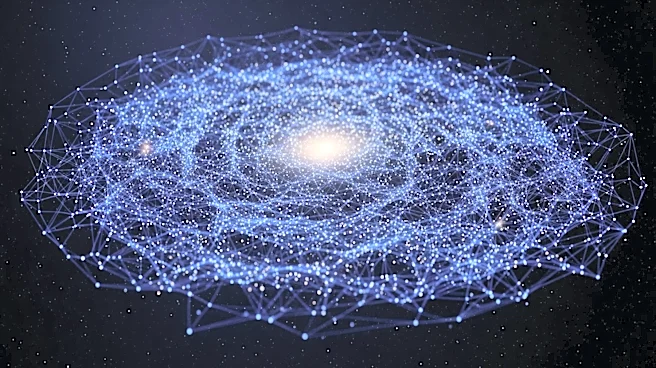
The Dark Energy Spectroscopic Instrument (DESI) has completed its observations, creating the most detailed 3D map of the universe to date. This map includes over 47 million galaxies and quasars, providing
new insights into the structure and evolution of the universe. DESI's data will be used to investigate dark energy, the mysterious force believed to drive the universe's accelerated expansion. The project, led by the Department of Energy's Lawrence Berkeley National Laboratory, involved over 900 researchers from 70 institutions worldwide.
Why It's Important?
DESI's comprehensive dataset represents a major advancement in cosmological research, offering a powerful tool for studying dark energy and the universe's expansion. The map's unprecedented detail allows scientists to test theories about the balance between dark energy and matter, potentially leading to significant changes in our understanding of the cosmos. The project's success demonstrates the value of international collaboration in tackling complex scientific questions and highlights the importance of large-scale observational efforts in advancing astrophysics.
What's Next?
Although the initial mission is complete, DESI will continue observing the sky through 2028, focusing on harder-to-observe regions. This ongoing work aims to build an even more detailed map of the cosmos, improving studies of nearby structures like dwarf galaxies and stellar streams. Researchers will also refine measurements of dark energy using the data collected, potentially leading to new discoveries and insights into the universe's future. The first results from the full five-year survey are expected in 2027.