





What's Happening?
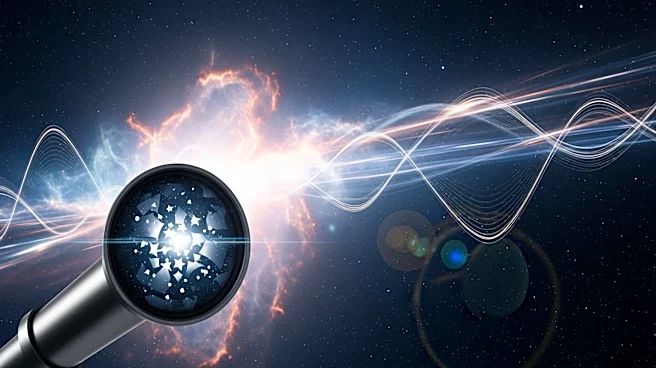
Astronomers from the Center for Astrophysics at Harvard University and the Smithsonian Institution have made a groundbreaking observation of interstellar turbulence distorting light in the interstellar medium. This phenomenon was observed as radio waves
from the quasar TXS 2005+403, located about 10 billion light-years away, passed through the turbulent Cygnus region of the Milky Way. The study utilized nearly a decade of data from the National Science Foundation's Very Long Baseline Array (VLBA), revealing structured, non-uniform distortions in the light caused by turbulence. This discovery is significant as it provides insights into the structure of turbulence in space and its effects on radio wave propagation.
Why It's Important?
The findings have substantial implications for astronomical research, particularly in improving the resolution of black hole images. The interstellar scattering observed contributes to the blurring of images of Sagittarius A*, the supermassive black hole at the center of the Milky Way, captured by the Event Horizon Telescope. By understanding how turbulence scatters radio waves, scientists can work towards mitigating these effects, potentially leading to clearer images of black holes. Additionally, the research enhances understanding of how energy is distributed in the galaxy and the behavior of gas before star formation, offering broader insights into galactic dynamics.
What's Next?
The research team has initiated a series of follow-up observations using the NSF VLBA radio astronomy network, which will continue through 2026. These observations aim to measure the specific properties of the turbulence and track its changes as the gas moves relative to Earth. This ongoing research will further refine the understanding of interstellar turbulence and its impact on astronomical observations, potentially leading to advancements in imaging techniques and a deeper comprehension of galactic processes.