
What's Happening?
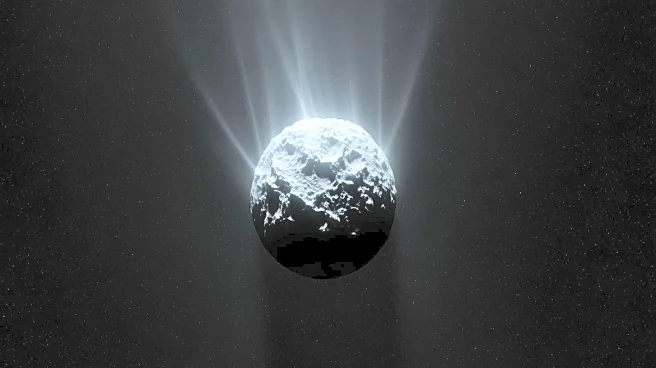
NASA has released new images of the interstellar comet 3I/ATLAS, taken by the Hubble Space Telescope. These images, captured on November 30, 2025, reveal the comet's active state as it approaches Earth.
The comet, designated C/2025 N1 (ATLAS), is the third confirmed interstellar object, following 1I/ʻOumuamua and 2I/Borisov. The Hubble images show a bright core surrounded by a halo of dust and gas, with the comet moving rapidly across the sky. The European Space Agency's Juice spacecraft also captured images, showing the comet's active state with two distinct tails. The comet is expected to make its closest approach to Earth on December 19, 2025, at a distance of approximately 170 million miles, posing no threat to the planet.
Why It's Important?
The observations of 3I/ATLAS provide a unique opportunity for scientists to study an interstellar object in detail. The comet's activity, including potential 'ice volcanoes,' offers insights into the chemical processes occurring on such objects. This data can help researchers understand the building blocks of planetary systems and the similarities between comets from different star systems. The comet's approach allows for extensive observation by various spacecraft, contributing to a comprehensive dataset that enhances our understanding of interstellar objects and their behavior as they pass through the solar system.
What's Next?
As 3I/ATLAS continues its journey through the solar system, scientists will continue to monitor its activity using various telescopes and spacecraft. The data collected will be analyzed to refine models of comet behavior and interstellar object composition. The comet's passage offers a rare chance to compare it with previous interstellar visitors, potentially reshaping theories about the formation and evolution of planetary systems. Observations will continue until the comet leaves the solar system, providing valuable information for future studies.
Beyond the Headlines
The study of 3I/ATLAS may reveal commonalities between interstellar comets and trans-Neptunian objects, suggesting shared chemical processes across different star systems. The comet's activity could offer clues about the conditions in its original planetary system, contributing to a broader understanding of the galaxy's composition. The extensive observation campaign highlights the importance of international collaboration in space exploration, as multiple agencies contribute to the study of this interstellar visitor.