







What's Happening?
The Atlantic States Marine Fisheries Commission’s Menhaden Management Board has voted to reduce the cap on industrial menhaden fishing. This decision, made at its annual meeting in Newport, Rhode Island, will see a coastwide catch limit reduction of approximately
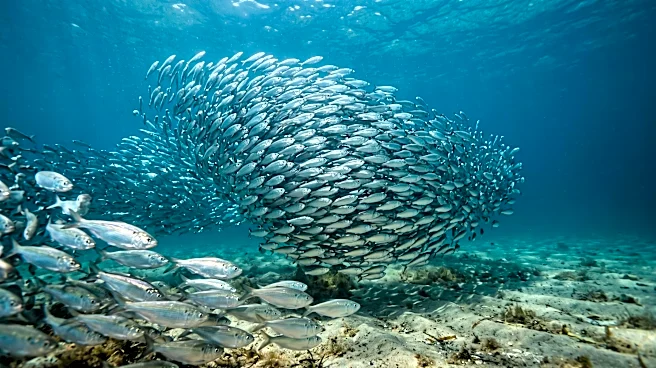
9% in 2027 and another 9% in 2028. Specifically for the Chesapeake Bay, the cap will be lowered by 27% in 2027 and 34% by 2028. These reductions follow a 20% cut implemented in 2026. Menhaden are small, oily fish crucial to the coastal ecosystem, serving as a food source for predators like ospreys and striped bass, and the Chesapeake Bay is a vital nursery for the species. The aquaculture industry heavily utilizes menhaden for fishmeal and oil, a process known as reduction fishing, which involves industrial fleets encircling dense schools of fish. The new coastwide limit will decrease from 186,840 metric tons this year to 170,000 metric tons in 2027 and 155,000 metric tons in 2028. The Chesapeake Bay cap for reduction fishing will drop from 51,000 metric tons to 37,123 metric tons in 2027 and 33,847 metric tons in 2028.
Why It's Important?
This decision is significant for the ecological health of the Chesapeake Bay and the broader Atlantic coast. Menhaden play a critical role as a forage fish, and their depletion can have cascading effects on the food web, impacting populations of larger fish and birds. Conservationists have raised concerns that industrial fishing practices contribute to the decline of predator species, citing the declining osprey population as a warning sign. Research from the Center for Conservation Biology at William & Mary indicated that 81% of monitored osprey nesting pairs in the Bay’s saltier waters failed to raise a chick in 2026, suggesting acute food stress. While the commission's technical committee found that a 39% cut would offer a 50% chance of meeting ecological fishing targets for striped bass, the adopted limits are less stringent. The commission acknowledged that the new limits will likely allow more fishing than the ecological target, though they claim no risk of overfishing against a looser limit. The economic impact on the multibillion-dollar aquaculture industry and the fishing communities that rely on menhaden for bait is also a key consideration, with Ocean Harvesters expressing disappointment over the cuts.
What's Next?
The new coastwide fishing limit will take effect on January 1, 2027, while the Chesapeake Bay cap will be implemented on May 1, 2027. The board decided to revisit the Bay cap at least every three years. A debate regarding the redistribution of the coastwide quota among states has been postponed until January. Virginia, which holds approximately 75% of the coastwide quota and hosts the only active menhaden processing plant on the Atlantic coast, opposed deeper cuts, while states like Maryland and North Carolina advocated for them. Virginia has allocated $2 million over two years for menhaden research to inform future Chesapeake Bay harvest caps, and Congress has approved an additional $2.5 million for Bay-specific research. Conservation groups like the Chesapeake Bay Foundation and the Theodore Roosevelt Conservation Partnership will continue to advocate for stronger protections and more scientifically informed management, including pressing Virginia lawmakers to implement observers on fishing vessels.
Beyond the Headlines
The ongoing debate surrounding menhaden fishing highlights a broader tension between economic interests and ecological preservation. The commission's decision to implement less stringent cuts than recommended by its own ecological targets underscores the challenges in balancing industry demands with environmental sustainability. The lack of comprehensive data on menhaden populations within the Chesapeake Bay and the specific impact of fishing on local ecosystems remains a critical gap. This situation raises questions about the effectiveness of current management strategies and the influence of powerful industry stakeholders. The differing opinions among states and the disappointment expressed by fishing companies like Ocean Harvesters suggest that this issue will continue to be a point of contention. The long-term health of the Chesapeake Bay, a vital national estuary, depends on effective management that prioritizes the ecological needs of its diverse species, including the foundational menhaden.