









What's Happening?
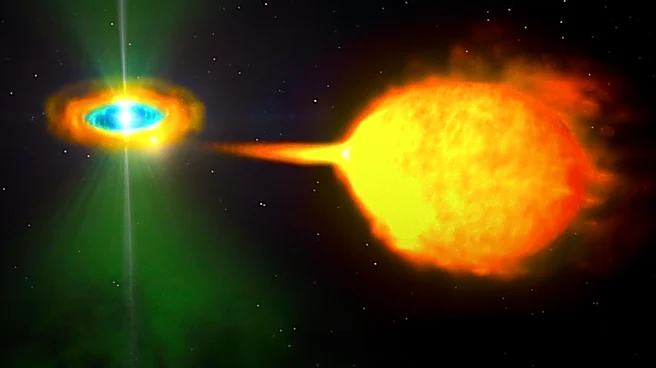
Astronomers have confirmed the existence of four previously hidden white dwarf stars in nearby binary systems, each within 65 light-years of Earth. These discoveries were made by researchers from the University of Warwick and the University of Colorado
Boulder, and published in the Monthly Notices of the Royal Astronomical Society. The white dwarfs were concealed by their brighter red dwarf companions, making them difficult to detect in visible light. The Hubble Space Telescope's ultraviolet observations were crucial in revealing these stellar remnants. One of the systems, G 203-47, located just 25 light-years away, took nearly three decades to confirm. This discovery aligns with predictions that our local stellar environment may contain many more undiscovered white dwarf binaries.
Why It's Important?
The discovery of these hidden white dwarfs is significant as it challenges existing models of stellar evolution and binary star systems. It suggests that there may be more undiscovered white dwarf binaries in our cosmic neighborhood, potentially altering our understanding of the local stellar population. This finding also highlights the limitations of visible light observations and the importance of using a range of wavelengths to uncover hidden astronomical phenomena. The presence of these white dwarfs could provide new insights into the life cycles of stars and the dynamics of binary systems, impacting future astronomical research and exploration.
What's Next?
The researchers suggest that further targeted efforts to observe red dwarfs could reveal additional hidden white dwarf companions. This could involve using advanced telescopes and techniques to systematically survey nearby red dwarfs. Such efforts may lead to the discovery of more binary systems, refining our understanding of the local stellar environment. Additionally, the unusual rotation of the G 203-47 system indicates that not all binary systems evolve in the same way, prompting further investigation into the evolutionary histories of these systems.