




What's Happening?
Hongsheng Zhang, a physicist at the University of Jinan in China, has presented research indicating that traveling into one's own past is impossible in a broad class of theoretical universes. The core of his argument rests on the principle that in relativity,
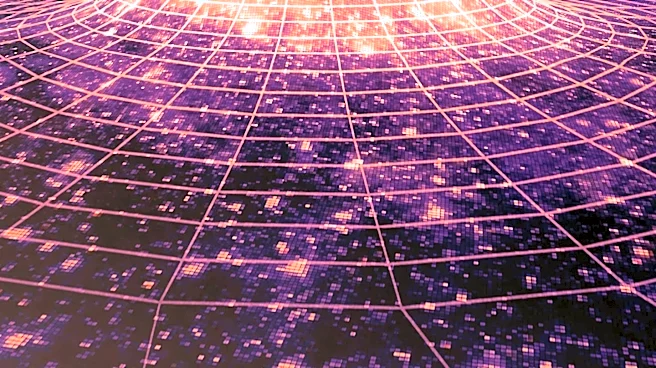
the direction of light can never be at right angles to an object's direction through time. This implies that anything moving slower or faster than light must traverse spacetime in a consistent direction, akin to climbing a staircase without the ability to descend. This research, which is currently awaiting peer review, suggests that the concept of 'closed timelike curves'—journeys through spacetime that loop back to their origin—are generally not feasible. Zhang's findings do not rely on exotic matter, quantum effects, or specific assumptions about the universe's composition, focusing instead on the fundamental directions within spacetime.
Why It's Important?
This research holds significant implications for theoretical physics and our understanding of the universe's fundamental laws. If widely accepted, it could reshape scientific perspectives on causality and the potential for temporal manipulation. While the study doesn't definitively rule out time travel to the past in our specific universe, it significantly narrows the theoretical conditions under which it might occur. For the scientific community, it provides a new framework for analyzing spacetime and the constraints on movement within it. The findings challenge popular cultural depictions of time travel, grounding the discussion more firmly in established physical principles. It underscores the complexity of spacetime and the profound limitations that may exist on altering the past, reinforcing the unidirectional nature of time as experienced in everyday life.
What's Next?
The next step for Zhang's research is the peer-review process, which will involve scrutiny and validation by other physicists. If the findings withstand this review, they could lead to further theoretical investigations into the specific conditions that might still allow for past time travel, such as those near spinning black holes or in universes with particular geometries. The scientific community will likely explore the implications of these findings for various cosmological models and theories of gravity. While practical time travel remains firmly in the realm of science fiction, this theoretical work contributes to a deeper understanding of the universe's structure and the boundaries of physical possibility. Future research may focus on experimental verification of related principles or the development of new theoretical models that incorporate these constraints.
Beyond the Headlines
Beyond its immediate scientific implications, Zhang's research touches upon profound philosophical questions about free will, determinism, and the nature of reality. The idea that the past is immutable and inaccessible to direct intervention reinforces a linear view of time, which has long been a subject of philosophical debate. Ethically, if time travel to the past were ever proven possible, it would raise immense concerns about paradoxes and the potential for altering historical events. By suggesting such travel is largely impossible, the research implicitly supports the stability of the past and the integrity of historical causality. Culturally, this work may influence how time travel is portrayed in fiction, potentially leading to more scientifically grounded narratives. It highlights the ongoing interplay between scientific discovery and our broader understanding of existence.